Description
Product Overview
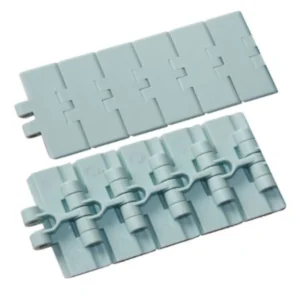
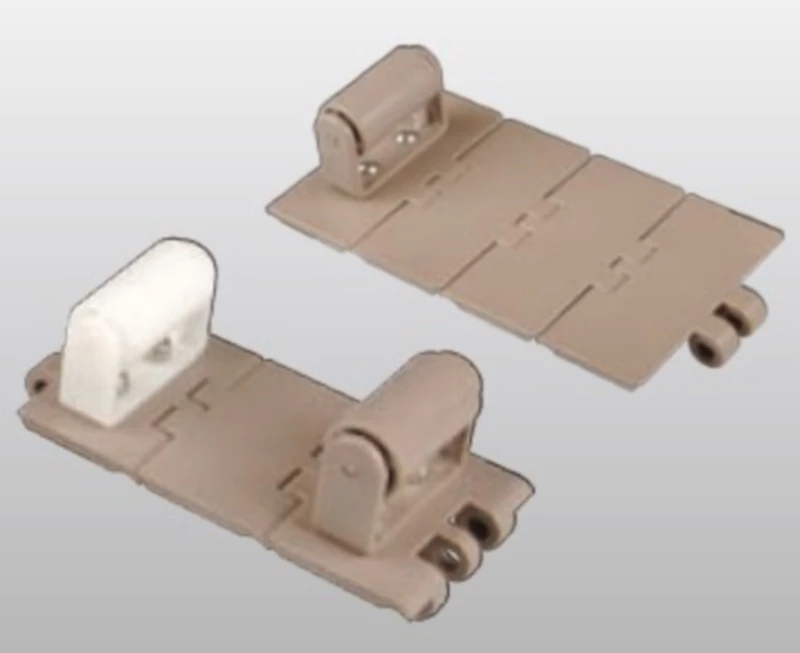
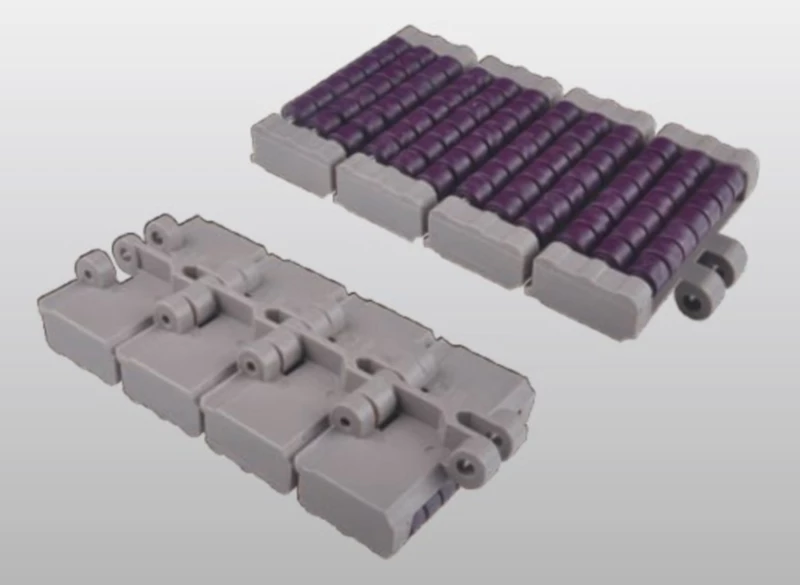
The LF820 lifting chain with rollers — also designated LBP820 in the low back-pressure series — is the zero-pressure accumulation solution built on the standard LF820 chain body architecture. Miniature rollers are integrated into the top surface of each link, projecting approximately 1.5–2.0 mm above the link plate. When product accumulates on this chain, it rests on the rotating roller tips rather than on the flat POM plate — converting the product-to-chain contact from sliding friction (CoF approximately 0.20) to rolling friction (CoF approximately 0.01–0.02). This 90–95% reduction in effective back-pressure friction allows accumulation zones of 3–5 metres to operate without product base deformation, container collapse, or label damage that would occur on standard flat-top chain at the same accumulation length and product weight. EverPower plastic chain Australia supplies the LBP820 roller chain across widths K118 to K750 as a direct replacement for System Plast equivalents.
The 820-body roller chain is distinguished from the heavier LBP821 double-hinge roller chain (covered separately) by its single hinge construction, narrower maximum width (K750 versus K1200 for LBP821), and lower maximum tensile strength. The LBP820 is the correct specification for narrow-to-medium width accumulation zones at standard product weights; the LBP821 is specified where accumulation zone width exceeds K750 or where product loads approach the LBP820’s tensile limit.
Technical Specifications
| Parameter | LBP820 (Roller Chain) | LF820 (Standard, Reference) |
|---|---|---|
| Chain pitch | 25.4 mm | 25.4 mm |
| Roller projection above plate | 1.5–2.0 mm | N/A (flat surface) |
| Back-pressure CoF (accumulation) | 0.01–0.02 | 0.18–0.22 |
| Back-pressure reduction vs standard | ~90–95% | — |
| Max. conveyor length (K325–K750) | ≤9 m | ≤24 m |
| Max. tensile strength | ≤2,000 N | ≤3,500 N (width dep.) |
| Max. speed (dry) | 60 m/min | 60 m/min |
| Width range | K118 to K750 | K118 to K1200 |
| Operating temperature | −40 °C to +90 °C | −40 °C to +90 °C |
| Packing | 10 ft / box | 10 ft / box |
How Back-Pressure Damages Products — and What Rollers Change
When product accumulates on a flat-top conveyor chain, the chain continues moving at drive speed under the stationary product mass. The friction force between the moving chain surface and the stationary product base is F = μ × N, where μ is the sliding coefficient of friction (approximately 0.20 for POM-on-PET or POM-on-glass) and N is the normal force (the product weight distributed through the accumulated column). On a 3-metre accumulation zone with a load density of 8 kg/m at chain speed, this generates a back-pressure of approximately 47 N on the downstream stop — enough to deform the base of a thin-wall 500 ml PET bottle by 0.5–1.0 mm at sustained accumulation.
On the LBP820 roller chain, product rests on the roller tips. The rollers rotate freely as the chain advances beneath the stationary product, converting the sliding contact to rolling contact. Rolling friction coefficient for POM roller on product base is approximately 0.01–0.02 — a 90–95% reduction from the sliding value. The same 3-metre accumulation zone at the same load density now generates only 2–5 N of back-pressure — below the deformation threshold for even thin-wall PET and glass containers. Line speed can be maintained at rated throughput without the speed reduction that would otherwise be required to protect the accumulated product.
Maximum Run Length: 9 Metres and the Reason Behind It
The LBP820’s maximum recommended conveyor run length of 9 metres is shorter than the standard LF820’s 24 metres. The constraint arises from two factors. First, the roller assembly adds weight to each link, increasing the total chain weight per metre and therefore the catenary tension at the tail drive under load. Second, the roller mechanism is a more complex assembly than a flat plate link — if chain tension exceeds the design limit, the roller axle posts are the first structural element to experience stress concentration, and their failure mode is more abrupt than simple link elongation.
For accumulation system designs requiring more than 9 metres of roller chain accumulation, the industry standard solution is tandem roller chain conveyors with a dead-plate transfer between sections, or a combination of a shorter LBP820 roller section (for the back-pressure-critical product contact zone) and a standard LF820 approach section upstream. The back-pressure problem is concentrated in the final 3–4 metres of the accumulation zone adjacent to the stop — the upstream approach sections can use standard flat-top chain without generating damaging back-pressure because accumulated product has not yet built up in that region.
Low-Noise Roller Design: POM on POM Contact
The rollers in the LBP820 are manufactured from POM and rotate on moulded POM axle posts. POM-on-POM contact at the roller-axle interface provides a self-lubricating, low-noise rolling action with no metal-to-metal contact in the roller assembly. In an open factory environment at typical line speeds, the roller chain accumulation zone typically produces 4–7 dB(A) less noise than an equivalent standard flat-top accumulation zone — a measurable improvement that contributes to occupational noise exposure reduction under Safe Work Australia guidelines.
Matched Components EverPower Supplies
| Component | Description | Availability |
|---|---|---|
| LBP820 Matched Sprockets | Roller-chain tooth profile, all K118–K750 widths | ✓ On request |
| Replacement Roller Assemblies | POM roller + axle unit, all LBP820 widths | ✓ On request |
| Standard LF820 Flat Top | For approach sections upstream of accumulation | ✓ In stock |
| LBP821 Double Hinge Roller Chain | For wider widths K750–K1200 accumulation zones | ✓ On request |
What Our Customers Say
“LBP820 K450 on our 3.5-metre 600 ml PET bottle accumulation buffer. We had 0.8% base deformation rejects before installation — enough to cause a weekly customer complaint from the packer. Four months after installation: zero deformation rejects. The roller chain resolved the problem completely at rated line speed.”
— Production Supervisor, Bottled Water Facility, Adelaide SA
“The 9-metre run limit led us to split our 15-metre accumulation zone into two 7-metre LBP820 sections with a short dead plate between them. EverPower’s team helped us size both sections and select the dead-plate transfer dimensions. The installation works exactly as designed — back-pressure across the full 15 metres is within specification.”
— Conveyor Systems Engineer, Beverage Production, Perth WA
“Noise reduction in our accumulation buffer is genuinely noticeable without measuring — the zone sounds qualitatively different. Our measured reduction was 6 dB(A), which brought the accumulation area below our continuous monitoring threshold. One less area on the mandatory hearing protection map.”
— EHS Coordinator, FMCG Production, Melbourne VIC