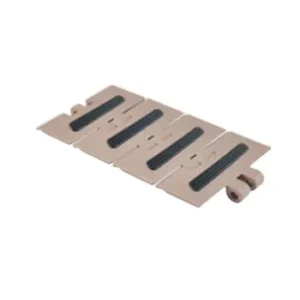
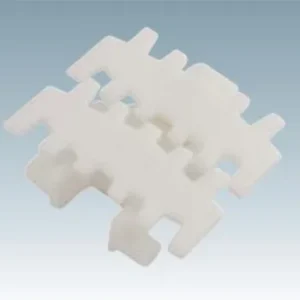
Description
Product Overview
A conveyor chain performs only as well as the sprockets and idler wheels that drive, guide, and support it. Mismatched sprockets are the single most preventable cause of premature plastic chain failure: incorrect tooth profile creates polygon effect oscillations that fatigue link plates at the hinge pin bore; undersized teeth fail to fully engage the chain, causing tooth skip under load; and worn sprockets transfer uneven tension across the chain width, producing early-stage catenary problems that cascade into chain tracking failures.
EverPower plastic chain Australia Pty Ltd supplies matched sprockets and idler wheels for the full System Plast-equivalent flexible chain range — N-L63, N-M83, N-H103, and N-175 series. All sprockets are precision-machined from engineering-grade polyamide (PA66) or stainless steel (SUS304), to the same dimensional standards used in the System Plast catalogue. Browse our full accessories range on the EverPower plastic chain website.
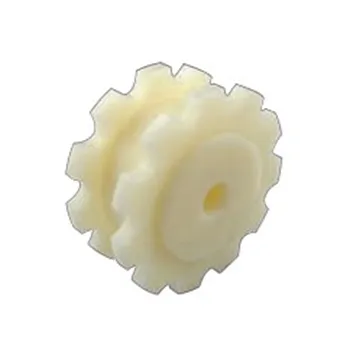
Sprocket Series and Specifications
Sprockets are precision-machined to match the chain pitch and link geometry of each flexible chain series. The correct sprocket has two key dimensional matches: the tooth pitch must match the chain link pitch exactly, and the tooth profile must match the chain link bottom geometry — neither too narrow (causing tooth skip) nor too wide (causing interference and rapid tooth wear). All EverPower sprockets are supplied in machined form, not injection-moulded, ensuring dimensional accuracy within ±0.05 mm across all critical tooth dimensions.
| Series | Chain Compatibility | Tooth Counts Available | Material Options | Bore Options |
|---|---|---|---|---|
| N-L63 Sprockets | N-L63P, N-L63 Cleat types | 8T, 10T, 12T, 15T, 18T | PA66 / SUS304 | 12 mm to 40 mm bore |
| N-M83 Sprockets | N-M83P, N-M83 Cleat types | 8T, 10T, 12T, 15T | PA66 / SUS304 | 15 mm to 50 mm bore |
| N-H103 Sprockets | N-H103P, N-H103 Cleat types | 8T, 10T, 12T | PA66 / SUS304 | 20 mm to 60 mm bore |
| N-175 Sprockets | N-175P, N-175 series | 6T, 8T, 10T | PA66 / SUS304 | 25 mm to 70 mm bore |
Sprocket Material Selection: PA66 vs SUS304
PA66 (nylon 66) sprockets are the standard choice for the majority of food and beverage conveyor applications. PA66 provides excellent wear resistance against the POM chain link bottom, a self-lubricating surface that reduces friction at the engage-disengage point, and low inertia due to its low density — an advantage on variable-speed drives where frequent acceleration and deceleration cycles stress the drive motor. PA66 also dampens the polygon effect vibration that is inherent in any chain-sprocket drive system, reducing transmitted noise levels by approximately 3–6 dB compared to a metal sprocket.
SUS304 stainless steel sprockets are specified where PA66 is not suitable: in zones where chemical cleaning agents above 85 °C are used directly on the sprocket, in environments with solvent vapours that would attack nylon, or in heavy-load drive configurations where the higher tensile strength of stainless steel provides a necessary safety margin at the tooth root. SUS304 sprockets are approximately 40% heavier than equivalent PA66 sprockets — a factor that matters on high-cycle indexing conveyors where sprocket inertia directly affects positioning accuracy.
Idler Wheels: Function and Selection
Idler wheels support the chain on the return strand, preventing it from dragging on the conveyor frame structure and reducing the friction load on the drive sprocket. A properly supported return strand reduces steady-state drive motor current by 8–15% compared to an unsupported return run — a meaningful energy saving on conveyors running 24 hours per day. Idler wheels are also positioned at the chain inlet and outlet of accumulation zones to prevent the chain from folding under the accumulated product backpressure.
EverPower idler wheels use a plastic outer ring (PA66 or UHMWPE) on a stainless steel axle, with a sealed bearing insert rated to the operating speed and load of the flexible chain series. The outer ring material is matched to the chain link bottom geometry — using the same material pair as the sprocket to maintain consistent wear characteristics across all chain contact points. Do not mix sprocket and idler materials (e.g., SUS304 sprocket with PA66 idler) on the same chain, as differential wear rates create uneven chain tension distribution.
Matching Sprockets to Chain: Critical Dimensions
Three dimensions determine sprocket-chain compatibility: (1) pitch — the distance from tooth centre to tooth centre, which must exactly match the chain link pitch; (2) tooth height — the radial engagement depth, which must fully clear the chain link bottom on the advance side and release cleanly on the disengage side; (3) sprocket width — the hub width must match the chain inner link plate gap to prevent lateral sprocket-to-chain interference. Measure all three dimensions on any worn sprocket before deciding whether to reuse it with a new chain. A sprocket worn below 60% of its original tooth height generates tooth skip and should be replaced simultaneously with the chain.
Matched Products and Accessories
| Component | Description | Availability |
|---|---|---|
| Plastic Flexible Chains (N-series) | Full range of plain and cleat chain bodies | ✓ In stock |
| Aluminium Beams (Guide Rails) | All N-series profiles, extruded aluminium | ✓ In stock |
| Wear Strip Inserts (UHMWPE) | For guide rail inner face, all series | ✓ On request |
| Drive Shaft Assemblies | Custom bore and keyway configurations | ✓ On request |
What Our Customers Say
“We ordered EverPower N-M83 PA66 sprockets alongside the chain and the tooth engagement was textbook from the first run. No break-in wear debris, no polygon effect noise. We ran a decibel meter comparison and the PA66 sprocket reduced conveyor noise by about 4 dB versus our old steel sprockets.”
— Process Engineer, Canned Beverage Facility, Brisbane QLD
“SUS304 sprockets on our CIP loop where the sprocket is directly in the wash zone. Twelve months of daily 80 °C alkali wash-down with no surface degradation. The PA66 sprockets we used previously started showing surface crazing at 5–6 months.”
— Maintenance Engineer, Dairy Processing Plant, Melbourne VIC
“We were sceptical about buying sprockets and chain from the same source, but the matched supply approach eliminated the fitment guesswork entirely. Commissioning time for our new conveyor line dropped from a planned two days to half a day.”
— Project Manager, Packaging Equipment Integrator, Sydney NSW