Description
Product Overview
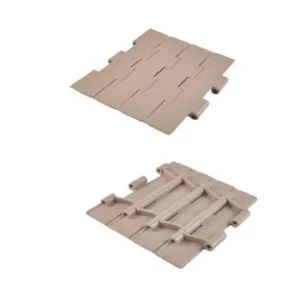
Flat top chains with low-noise accumulation rollers are the engineering solution to one of the most persistent and costly problems on high-throughput packaging and beverage lines: accumulation back-pressure damage. When products accumulate against a downstream stop on a standard flat top chain, the chain continues moving under the stationary product mass, generating sliding friction between the chain surface and the product base. On a 3-metre accumulation zone running at 60 m/min with 20 kg/m of product load, this friction creates a back-pressure force on the stop of approximately 60–90 N — enough to deform thin-wall PET bottles, scuff carton bases, and cause label wrinkling on shrink-wrapped products. The roller chain eliminates this force by replacing sliding friction with rolling contact. EverPower plastic chain Australia Pty Ltd supplies the complete LBP-series roller flat top chain range — LBP831 (single hinge) and LBP821 (double hinge) — as direct replacements for System Plast equivalents, across widths from K325 to K1200.
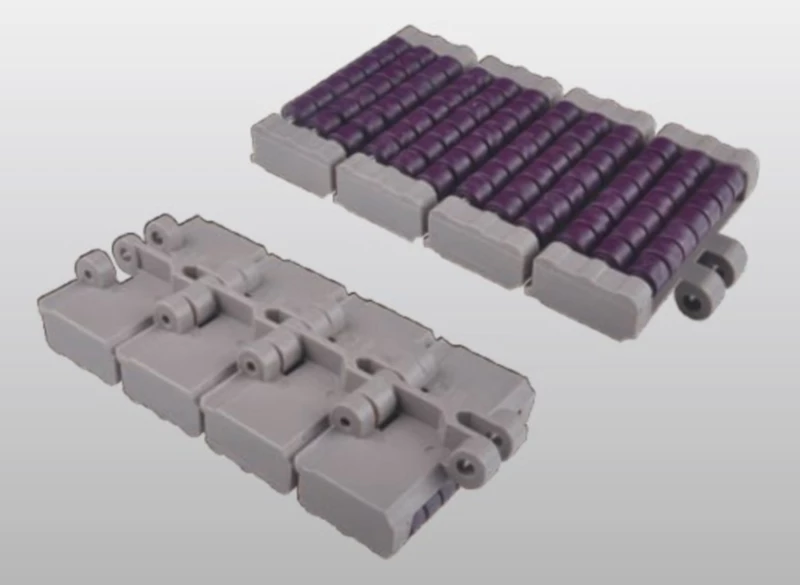
The LBP designation (Low Back-Pressure) encodes the primary design intent. Rollers mounted in the chain link surface project 1.5–2.5 mm above the plate and rotate on fixed axles. When product accumulates on the chain, it rests on the roller tips rather than on the flat plate surface — converting the sliding contact to rolling contact and reducing the back-pressure coefficient of friction from approximately 0.20 to 0.01–0.03. Learn more at the About Us page.
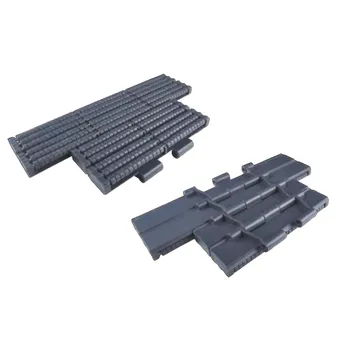
LBP Series Models and Width Designations
| Model | Hinge Type | Width Range (K-designation) | Roller Material | Key Application |
|---|---|---|---|---|
| LBP831-K325 | Single | 325 mm | POM low-noise | Light product accumulation, vials, small bottles |
| LBP831-K450 | Single | 450 mm | POM low-noise | Standard beverage single-file accumulation |
| LBP821-K750 | Double | 750 mm | POM low-noise | Wide accumulation, multipacks |
| LBP821-K1000 | Double | 1000 mm | POM low-noise | Wide beverage case accumulation |
| LBP821-K1200 | Double | 1200 mm | POM low-noise | Maximum width, heavy case accumulation |
| LBP8257-K750 | Double heavy-duty | 750 mm | PA66 reinforced | High load heavy-duty accumulation |
| LBP8257-K1000 | Double heavy-duty | 1000 mm | PA66 reinforced | Heavy-duty wide format |
| LBP8257-K1200 | Double heavy-duty | 1200 mm | PA66 reinforced | Maximum load heavy-duty |
The Back-Pressure Problem: Why Standard Flat Top Chain Falls Short
Standard flat top chains are designed for product transport — moving product from one point to another at line speed. Accumulation is not their primary design mode, and using a standard flat top chain for accumulation above 1–1.5 metres in length creates increasing back-pressure as the accumulated product column grows. At 3 metres of accumulation with a standard POM chain surface at CoF 0.20, and a product load of 10 kg/m, the back-pressure on the downstream stop is approximately 60 N. This force is distributed across the bottom tier of products in the accumulated column and can be sufficient to cause visible deformation in 500 ml PET bottles at thin-wall regions near the base.
The industry standard correction for this problem — reducing line speed in the accumulation zone — reduces throughput and creates a bottleneck. The LBP roller chain solution maintains full line speed while keeping back-pressure below the damage threshold. On a typical 500 ml PET bottle line, the roller chain at CoF 0.02 generates only 6 N of back-pressure on the same 3-metre accumulation with the same product load — well below the 15–20 N threshold for base deformation. The line runs at full speed without stop damage.
Low-Noise Roller Design: Reducing Accumulation Zone Noise
Standard accumulation rollers on older chain designs use metal axle pins that generate noise as accumulated product presses rollers against the axle under back-pressure load. The LBP roller design uses a POM roller on a moulded plastic axle boss, eliminating metal-to-metal contact in the roller-axle interface. Under product load, the POM roller deforms microscopically at the contact point with the axle, increasing the effective contact area and damping the vibration that manifests as noise. Measured noise levels in an accumulation zone at 60 m/min are typically 5–9 dB(A) lower with POM-roller LBP chains compared to older metal-roller designs — a reduction perceptible as meaningfully quieter in an open factory environment.
LBP8257 Heavy-Duty Series: PA66 Rollers for High-Load Applications
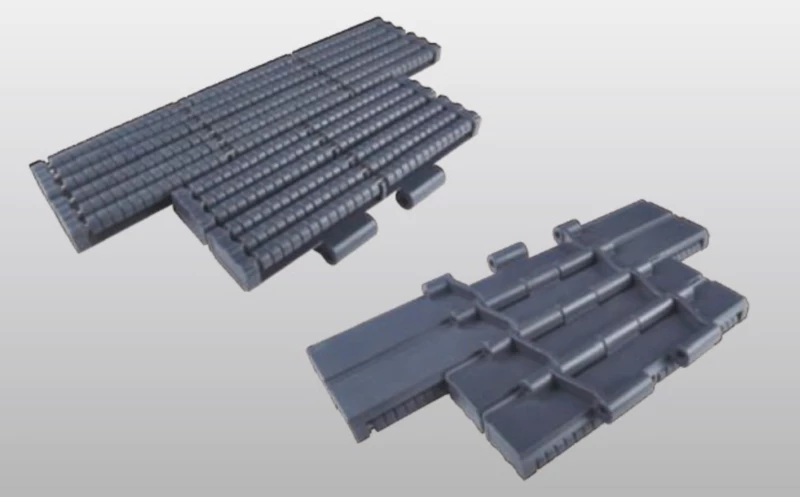
The standard LBP831 and LBP821 use POM rollers suited to product loads up to approximately 15 kg/m of chain. For applications with higher product loads — heavy glass bottles in full-width accumulation zones, dense metal cans, or heavyweight cartons — the LBP8257 heavy-duty series uses PA66 (nylon 66) rollers with a higher compressive yield strength. PA66 rollers under sustained high point load maintain their cylindrical geometry more effectively than POM at equivalent loads, preventing the flat-spotting that degrades rolling performance on lightly loaded POM rollers after extended accumulation at high product weight.
LBP8257 is the specified chain for wide-format glass bottle accumulation in Australian wine and spirits production — an application that combines high product weight, full-width 1000–1200 mm chain format, and sustained accumulation periods during downstream stoppages. The double hinge design and PA66 roller combination provides the load capacity and back-pressure performance required without the capital cost of a fully servo-controlled zero-pressure accumulation table.
Matched Components EverPower Supplies
| Component | Description | Availability |
|---|---|---|
| LBP831 / LBP821 Sprockets | Matched to roller chain tooth profile, all widths | ✓ On request |
| Replacement Rollers (POM) | LBP831 and LBP821 series, individual or strip | ✓ On request |
| Replacement Rollers (PA66) | LBP8257 series heavy-duty | ✓ On request |
| Standard LF820 / LF821 Flat Top | For non-accumulation sections on same line | ✓ In stock |
What Our Customers Say
“LBP831 at K450 on our 4-metre 500 ml PET accumulation zone. Before the roller chain installation, we were running 20% below rated speed to control bottle deformation. After installation, full rated speed with zero deformation events in 6 months. The throughput recovery alone justified the cost within 8 weeks.”
— Production Manager, Beverage Bottling, Adelaide SA
“LBP821 at K1000 on our beer multipack accumulation table. Accumulation noise in that zone dropped from 78 dB to 70 dB — our noise survey team recorded it and the improvement is documented. The occupational exposure calculation for operators working adjacent to the table changed category as a result.”
— EHS Manager, Brewery Production Facility, Melbourne VIC
“LBP8257 at K1200 on our wine bottle accumulation conveyor. Heavy glass at full width — the PA66 rollers have maintained their round profile at 11 months. POM rollers on a previous trial chain had flat-spotted by month 6 under the same load. The heavy-duty roller is clearly the correct specification for this application.”
— Engineering Manager, Wine Production, Barossa Valley SA