Description
Product Overview
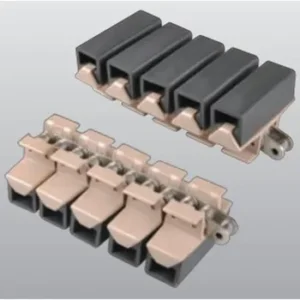
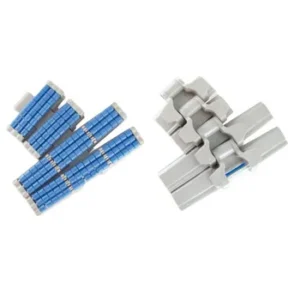
Double hinge flat top chains use two hinge pins per link instead of the single pin used in standard flat top chains. This seemingly simple change has substantial engineering consequences: the double pin distributes hinge bending load across two contact points, halving the contact stress at each pin-to-link interface and significantly extending hinge wear life on wide, heavily loaded conveyor sections. For conveyor widths above approximately 250 mm running at moderate to high throughput, the double hinge design is the recommended standard rather than an optional upgrade — the single hinge equivalent will exhibit measurable hinge bore wear within 12–18 months, while the double hinge counterpart on the same application typically achieves 24–36 months before the same wear threshold is reached. EverPower plastic chain Australia Pty Ltd supplies double hinge straight running flat top chains — primarily the LF821 series as a direct replacement for System Plast 821.
The LF821 is mechanically compatible with the same guide rail and sprocket profiles as the LF820 single hinge series, allowing direct in-situ replacement on existing conveyor frames. The only hardware change required is specifying the correct double-hinge sprocket engagement profile. For new installations designed from the start with the double hinge chain, the structural benefits are fully realised from commissioning day one.
Single vs Double Hinge: The Engineering Case
On a straight running chain, each hinge pin is subjected to bending stress as the chain wraps around the drive and tail sprockets. The bending stress at the pin surface is proportional to the load per unit length of pin. For a single hinge pin spanning the full chain width, the stress is concentrated at the midspan — the point of maximum bending moment. As chain width increases, the midspan bending moment increases with the square of the width, meaning a chain twice as wide experiences four times the midspan bending stress for the same linear load.
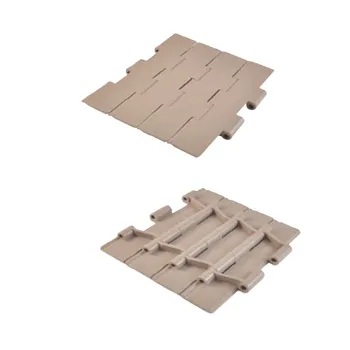
The double hinge design places two pins symmetrically across the chain width, reducing the effective span of each pin to approximately half the chain width. This reduces the midspan bending moment by a factor of four for the same load — restoring manageable stress levels for wide chains. The practical outcome is that the hinge bore in the link body, which wears as the pin rotates under this bending load, wears at a dramatically lower rate. Measured bore elongation rates on double hinge chains in service typically run at 40–60% of the rate observed on single hinge chains of equivalent width at the same operating conditions.
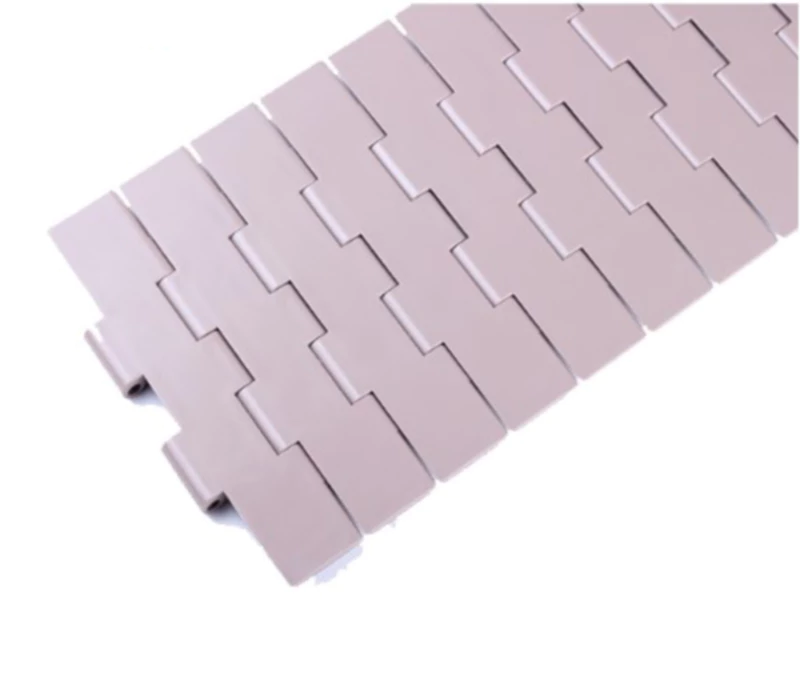
LF821 Series: Width Range and Load Ratings
| Chain Series | Hinge Type | Typical Width Range | Max Speed (lub.) | Max Speed (dry) | Design Load |
|---|---|---|---|---|---|
| LF821 | Double | K750 to K1200 (750–1200 mm) | 90 m/min | 60 m/min | Medium-high |
| LF821G | Double + Rubber Top | K750 to K1200 | 60 m/min | 40 m/min | Medium |
| LF821 Anti-Static | Double ESD | K750 to K1200 | 90 m/min | 60 m/min | Medium-high |
Width designations follow the K-prefix convention: K750 indicates a 750 mm chain width, K1000 is 1000 mm, K1200 is 1200 mm. These designations correspond to the conveyor frame opening width the chain is designed to operate within, not the nominal outer dimension of the chain itself — the chain outer dimension is typically 2–4 mm less than the K-designation to allow for guide rail clearance.
Application Areas Where Double Hinge Outperforms
Wide-format beverage case conveying is the most common application driver for the LF821. A single-strand double hinge chain at 750–1000 mm width can carry a full row of 24-pack beer cases — approximately 12–15 kg per row at standard case dimensions — across accumulation zones and transfer sections without the hinge distortion that would occur with a single hinge chain at the same width. The smooth, flat top surface of the LF821 allows cases to slide laterally for sortation and merging without the surface interruptions that would cause cardboard base damage.
Wide-format secondary packaging — shrink-wrapped multipacks, tray packs, and wrapped pallet layers — also makes extensive use of double hinge flat top chains. In these applications the chain must support an asymmetrically loaded product (the pack weight may be concentrated on one edge if the packing is not perfectly centred), and the double hinge design accommodates this torsional load without the single-hinge pin deflecting laterally out of its bore.
Rubber-Top Variant (LF821G): Incline and Grip Applications
The LF821G adds a vulcanised rubber strip to the top surface of the double hinge chain at regular intervals, increasing the effective coefficient of friction from approximately 0.15–0.25 (standard POM surface) to 0.50–0.70. At 750–1000 mm chain width, this is used for wide inclined conveying sections where the product mass is high enough that standard POM surface friction is insufficient to prevent back-slip without supplementary guide rail fences. The rubber-top double hinge combination is specified for wide-format tray conveying on inclines up to approximately 20° in food distribution and retail DC environments.
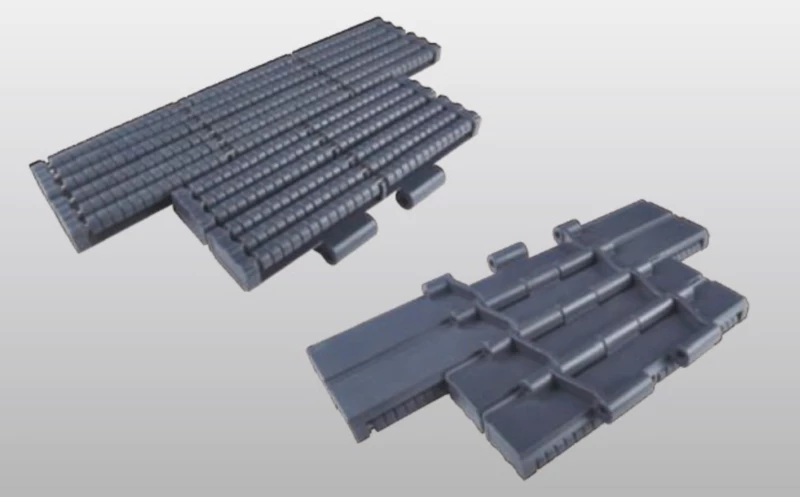
Matched Components We Also Supply
| Component | Description | Availability |
|---|---|---|
| LF821 Double-Hinge Sprockets | Matched tooth profile and width, POM / SUS304 | ✓ On request |
| Stainless Steel Double Hinge Pins | For all LF821 widths, individual or bulk pack | ✓ In stock |
| UHMWPE Wear Strips | Cut to width for all LF821 beam profiles | ✓ On request |
| LF820 Single Hinge Chains | Standard width for narrower sections on same line | ✓ In stock |
What Our Customers Say
“LF821 1000 mm wide on our beer case accumulation line. We used to run LF820 800 mm and had frequent hinge wear by month 14. Since moving to the double hinge LF821 wide format, we are at 22 months with measured hinge bore wear still within spec. The engineering argument for double hinge is real.”
— Maintenance Manager, Brewery Distribution Centre, Sydney NSW
“Our wide-format shrink-wrap conveyor runs mixed pack sizes — 6-pack to 24-pack — with the full width loaded asymmetrically by varying product. The LF821 handles the torsional load without any visible lateral pin movement. Previous single hinge chain developed perceptible pin rocking within 9 months on this application.”
— Packaging Engineer, FMCG Distribution, Melbourne VIC
“We specified LF821G rubber top for a 15° incline conveying 10 kg retail multipacks. The rubber strip pattern provides consistent grip across the full 900 mm width. No back-slip incidents in 8 months of operation — a complete contrast to the smooth POM chain we trialled first.”
— Conveyor Project Manager, Retail Distribution Centre, Brisbane QLD