Description
Product Overview
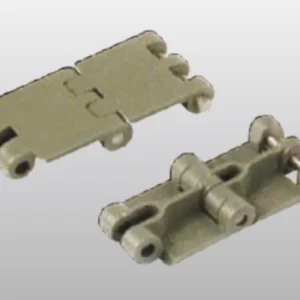
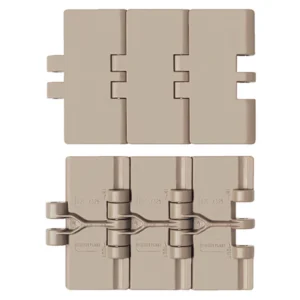
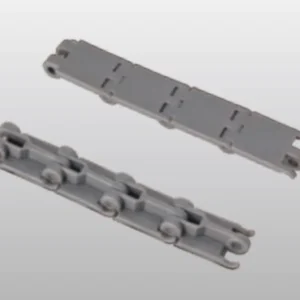
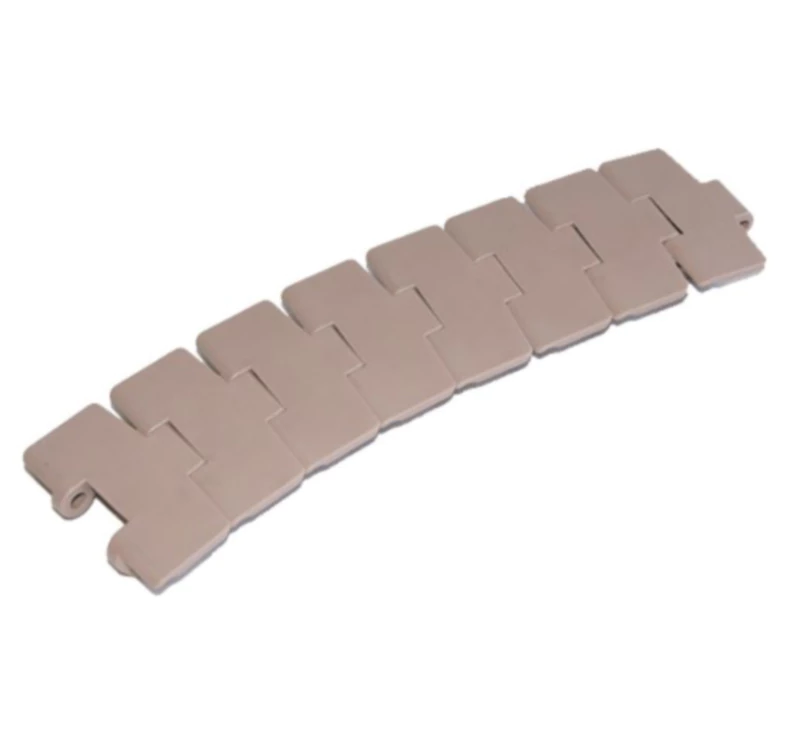
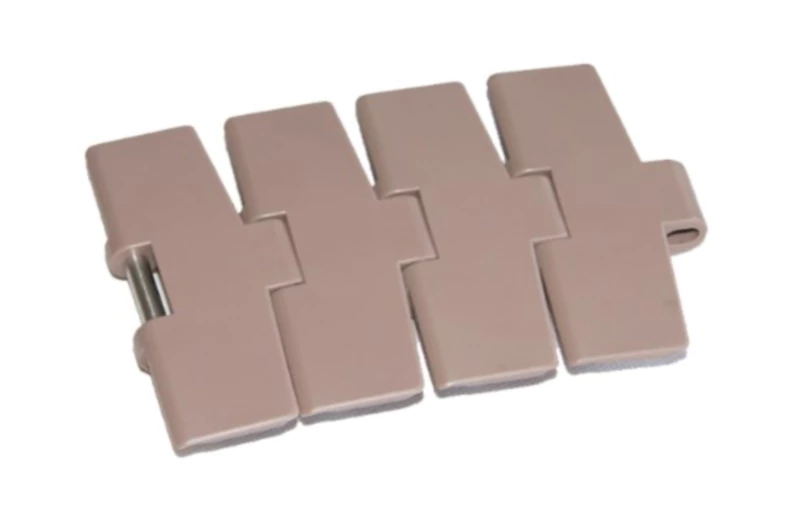
The LF880 bevel sideflexing flat top chain is the standard specification for curved conveyor sections in food and beverage manufacturing — the System Plast 880 equivalent that enables horizontal curve handling without mechanical curve units. The bevel edge design cuts a chamfered profile onto the outer corner of each link plate. As the chain enters a horizontal curve, adjacent link plate bevel faces close against each other, controlling the maximum lateral flex angle per link and maintaining a smooth, gap-free top surface through the curve. EverPower plastic chain Australia supplies the LF880 bevel sideflexing series across widths K118 to K1200 as a direct replacement for System Plast 880.
The LF880 operates within a maximum chain tension of 2,250 N and a maximum recommended straight-section run of 9 m — the shorter maximum run compared to the LF820 reflecting the additional link plate mass of the bevel geometry and the inherently higher chain tension that sideflexing chains experience at the outer radius of each curve. Maximum dry-run speed is 60 m/min; maximum lubricated speed is 90 m/min. Standard packing is 10 ft (3.048 m) per box at 26 links per metre.
Operating Parameters
| Parameter | Value |
|---|---|
| Chain pitch | 25.4 mm |
| Curve capability | Bevel edge sideflexing, min. inner radius ~600 mm (width-dependent) |
| Top plate material | POM-C |
| Pin material | SUS304 stainless steel |
| Working load | ≤2,250 N |
| Max. straight run | ≤9 m |
| Max. speed (dry) | 60 m/min |
| Max. speed (lubricated) | 90 m/min |
| Operating temperature | −40 °C to +90 °C |
| Width range | K118 to K1200 |
| Packing | 10 ft / box; 26 links/m |
Bevel Edge Sideflexing: How the Geometry Creates the Curve
The bevel edge on the LF880 link plate is a chamfered cut on the outside face of the plate — the face that faces outward on a horizontal curve. When the chain enters a curve to the left, each link’s left-side bevel face closes toward the left-side bevel face of the next link behind it. The angle of the bevel face determines how far the chain can flex before the bevel faces make contact and stop further flexing — this contact point defines the minimum inner bend radius of the chain.
The key property of the bevel geometry is that the chain top surface remains continuous through the curve. Adjacent link plates overlap in the horizontal plane as the chain curves, and the bevel face geometry is designed so that the top plate edge of each link passes over the top plate surface of the adjacent link without creating a step or gap. A smooth, flat surface is maintained from outer radius to inner radius throughout the curve — a critical requirement for stable product transport through a curve without tip events at the plate transition points.
Minimum Bend Radius and Width Relationship
The minimum achievable inner bend radius of the LF880 increases with chain width. At K118, a minimum inner radius of approximately 400–500 mm is achievable. At K600, the minimum inner radius increases to approximately 750–900 mm. At K1200, the minimum inner radius may be 1,200–1,500 mm. This relationship is inherent to the bevel geometry: wider chains have longer link plates, and the bevel contact occurs at a larger radius for the same bevel angle. Engineers specifying LF880 for wide-chain applications should verify the minimum bend radius at their target width before committing to a conveyor layout that assumes a tighter curve.
For curve radii tighter than the LF880 bevel minimum, the LF880TAB (tab-link sideflexing variant) achieves approximately 30–40% tighter curves at equivalent widths by using a different link geometry. The TAB variant is covered in the LF880TAB product page. If your required curve radius is above the LF880 bevel minimum, the standard LF880 is the more economical and structurally simpler choice.
Outer Radius Guide Rail Forces: A Critical Design Variable
When a sideflexing chain runs through a horizontal curve, the chain’s tendency to run straight creates a centrifugal-like side force directed toward the outer radius of the curve. This force is proportional to chain speed squared and to the mass of the chain-and-product system per unit length. At K450, 40 m/min, and 10 kg/m product load, the side force on the outer guide rail is approximately 8–12 N/m of curve. At K750, 60 m/min, and 15 kg/m, the same calculation yields approximately 35–45 N/m.
The outer guide rail must be designed to absorb this force without deflecting — under-dimensioned aluminium rail profiles will bow outward under sustained side force, allowing the chain to climb the rail and eventually derail. EverPower recommends guide rail selection based on the calculated outer radius side force for each curve section. For forces above 25 N/m, steel-backed aluminium composite rails or heavy-section aluminium extrusions are specified rather than standard light-extrusion profiles.
LF880 Variants: Anti-Static and Magnetic
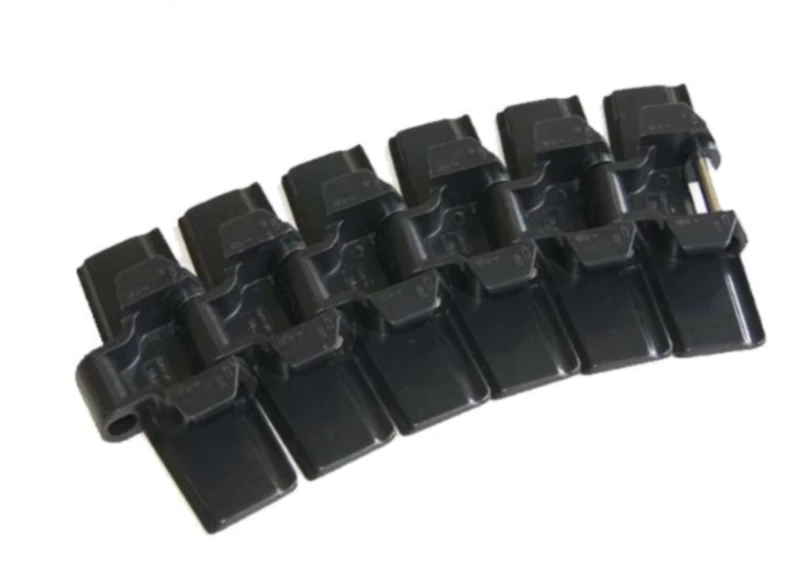
Two functional variants of the LF880 bevel sideflexing chain are available beyond the standard POM construction. The LF880 anti-static (ESD) variant uses carbon-black loaded POM with surface resistivity 10⁴–10⁶ Ω/sq — specified for electronics assembly lines, explosive atmosphere zones, or film packaging lines where static charge accumulation on the chain surface causes product cling or discharge risk through the conveyor curve section.
The LF880M magnetic variant integrates rare-earth magnets into the bevel link body, providing magnetic holding force on ferrous products through both straight runs and horizontal curves. The magnetic holding force of approximately 10–14 N per magnet-equipped link at a 2 mm working gap is sufficient to retain steel cans and tinplate lids through curves at speeds up to 40 m/min without side guide rails. This is the standard specification for steel can conveying through curves on filling and decorating lines where format-specific guide rail adjustment would otherwise be required.
Matched Components EverPower Supplies
| Component | Description | Availability |
|---|---|---|
| LF880 Curve Sprockets (inner/outer) | All K-widths, matched to 880 bevel pitch | ✓ On request |
| Aluminium Curve Guide Rails | Inner and outer radius, heavy and standard section | ✓ On request |
| LF880TAB (Tab-Link Sideflexing) | For tighter curve radii on the same line | ✓ On request |
| LF820 Straight Flat Top | For straight sections adjacent to LF880 curves | ✓ In stock |
What Our Customers Say
“LF880 K325 on a 90° curve with 650 mm inner radius on our PET bottle transport line. The bevel geometry maintains a completely gap-free surface through the curve — no bottle tips at the plate transition since installation. At 45 m/min, the curve runs smoothly with no audible chain-to-rail contact. Well-engineered product.”
— Conveyor Engineer, PET Bottle Production, Sydney NSW
“LF880M magnetic bevel chain on our steel can decorator curve. We eliminated the format-specific guide rail spacers at this section entirely. The magnetic hold keeps the cans in position through the 180° curve at 35 m/min regardless of can diameter within our standard format range. Format changeover at this section is now zero-time.”
— Production Manager, Can Decorating, Melbourne VIC
“LF880 anti-static K252 on our PCB transport curve section. No ESDs since installation — previously we were seeing one event per week in this section with standard POM chain. The anti-static variant is mechanically identical to standard LF880, so no changes to the conveyor frame or sprockets were required.”
— Electronics Manufacturing Engineer, Brisbane QLD