Description
Product Overview
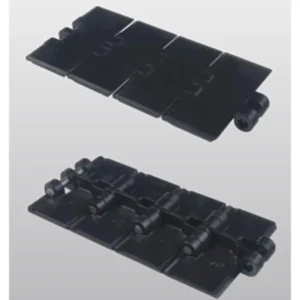
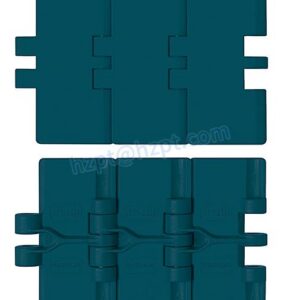
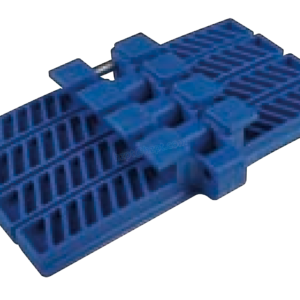
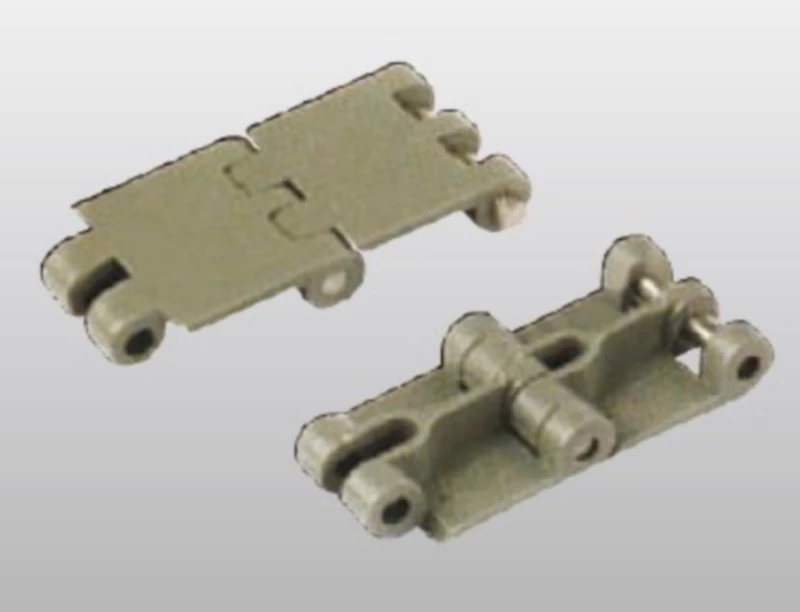
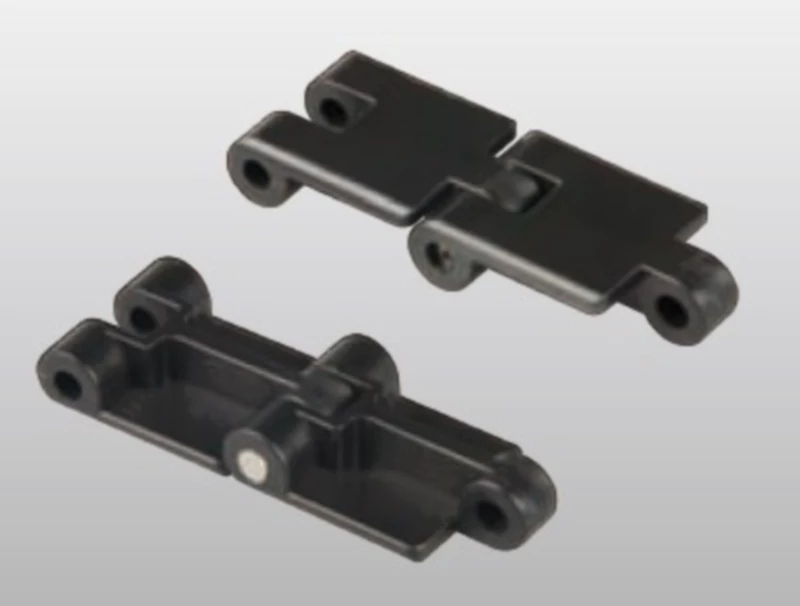
The LF820 mini straight chain series — specifically the twin-plate or rigid-body mini straight configuration — addresses conveying applications where the standard mini flat top chain’s single-plate link body provides insufficient rigidity in the direction perpendicular to travel. In standard mini flat top chain, each link is a single moulded plate connected to adjacent plates by a single hinge pin. The twin-plate configuration adds a second parallel plate beneath the first, connected by a structural web — increasing the second moment of area in the vertical direction and producing a stiffer, more dimensionally stable conveying surface under asymmetrically loaded or point-loaded product contact. EverPower plastic chain Australia Pty Ltd supplies this configuration as a direct replacement for System Plast 820 mini straight chains in the twin-plate geometry, from K118 to K450.
Operating parameters are consistent with the broader mini flat top family: 10 ft (3.048 m) per box, 26 links per metre nominal packing count, maximum conveyor length 12 m, maximum tensile strength 1,230 N, and maximum speed 60 m/min dry-run. The twin-plate construction adds slightly to the chain weight per metre but provides measurably improved flatness retention under concentrated product loads — a relevant advantage in inspection line applications where flatness directly affects vision system performance.
Twin-Plate Construction: The Engineering Rationale
The flatness tolerance of a single-plate mini chain link under product load is governed by the plate’s bending stiffness in the vertical direction. For a POM plate of typical mini chain thickness (approximately 2–3 mm) and length (approximately 15 mm at mini pitch), the vertical bending stiffness is low enough that a 50-gram point load at the centre of a link causes a deflection of approximately 0.15–0.25 mm from the plane of the unloaded adjacent links. On a single-file vial line this deflection is insignificant. On a multi-file line where 4–6 vials sit side-by-side across a K325 or K450 chain width, the cumulative deflection across the loaded width creates a transverse slope of 0.3–0.5 mm that can cause vials at the chain edges to lean slightly inward — increasing tip probability at guide rail contact points.
The twin-plate mini chain’s structural web increases the effective plate second moment of area by a factor of approximately 3–4, reducing vertical deflection under the same load to 0.04–0.08 mm — well below the threshold that causes measurable product lean. This stiffness improvement costs approximately 15–20% additional chain weight per metre but eliminates the multi-file instability problem without requiring the additional guide rail hardware that would otherwise be needed to correct the leaning.
Width Range and Application Guidance
| Width | Typical Product Lanes (vials) | Vertical Stiffness vs Standard Mini | Recommended Application |
|---|---|---|---|
| K118 | 1–2 | +200% | Single or dual-file small products, tight-space installations |
| K190 | 2–3 | +250% | Dual-file pharmaceutical vials, cosmetic tubes |
| K252 | 3–4 | +280% | Multi-file small product conveying, inspection lines |
| K325 | 4–6 | +300% | Wide multi-file vial lines, multi-lane inspection |
| K450 | 5–8 | +320% | Maximum width mini chain, high-capacity multi-file lines |
Inspection Line Applications: Where Flatness Drives Product Quality
Camera-based inspection systems for pharmaceutical vials, ampoule fill levels, and label verification require the product to be presented at a consistent height relative to the camera focal plane. On standard single-plate mini chain, the slight vertical deflection under product load shifts the effective product height by 0.15–0.25 mm — a variation that is within the depth of field of lower-resolution inspection cameras but outside the tolerance of high-resolution line-scan cameras used for label text verification and particulate detection in clear solutions.
Twin-plate mini chain reduces this height variation to 0.04–0.08 mm — within the depth of field of virtually all pharmaceutical inspection camera systems currently in use in Australian manufacturing. For facilities upgrading from legacy lower-resolution inspection to high-resolution automated vision systems, switching from standard single-plate to twin-plate mini chain as part of the inspection system upgrade is a frequently recommended parallel change that ensures the conveyor surface performance keeps pace with the camera system capability.
Integration with Standard LF820 on the Same Line
A common installation pattern combines twin-plate mini straight chain at the inspection station with standard LF820 chain on the transport sections upstream and downstream. The inspection section — typically 2–4 metres in length — uses the twin-plate mini chain for its flatness and height consistency benefits. The adjacent transport sections use standard LF820, which has sufficient flatness tolerance for transport and accumulation functions and is more economical per metre than the twin-plate mini.
Both chain types use compatible guide rail profiles and the same general drive system architecture. The transition between the two chain types requires a dead-plate or transfer plate at the chain boundary — the different link pitch between mini chain and standard chain means they cannot share a common sprocket. Each conveyor section (mini and standard) has its own drive and tail sprocket, and product transfers across a short dead-plate between them. This is standard practice in pharmaceutical line engineering and is fully documented in conveyor layout guidelines from System Plast and equivalent manufacturers.
Matched Components EverPower Supplies
| Component | Description | Availability |
|---|---|---|
| LF820 Mini Straight Chains Sprockets | Twin-plate mini pitch, all K-widths | ✓ On request |
| Dead-Plate Transfer Assemblies | For mini-to-standard chain transition points | ✓ On request |
| Standard LF820 Flat Top | For transport sections adjacent to inspection | ✓ In stock |
| LF820 Mini Single Hinge (P25) | For alternative mini configuration on same system | ✓ In stock |
What Our Customers Say
“Twin-plate mini straight K325 at our ampoule fill-level inspection camera. We upgraded to a high-resolution line-scan camera and the first thing the camera OEM told us was that our chain flatness was causing focus errors on the outer lanes. Twin-plate mini chain resolved it immediately — all six lanes in focus, inspection accuracy at specification.”
— Validation Engineer, Sterile Manufacturing, Sydney NSW
“K252 twin-plate mini chain on our multi-file cosmetic tube inspection line — four tubes side by side. The rigid body prevents the outer tubes from leaning at the guide rail contact. We eliminated the lateral guide pressure adjustment that we were making every week to compensate for the lean on the standard single-plate chain.”
— Process Engineer, Cosmetics Manufacturing, Melbourne VIC
“The integration between the twin-plate mini section and the standard LF820 transport sections was explained clearly by EverPower’s technical support. The dead-plate transfer dimensions and the drive sprocket selection for both sections were confirmed before we ordered. First installation went exactly to plan.”
— Project Manager, Pharmaceutical Line Installation, Brisbane QLD