Description
Product Overview
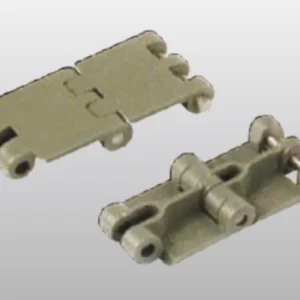
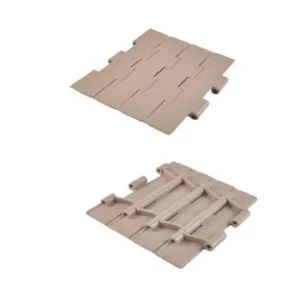
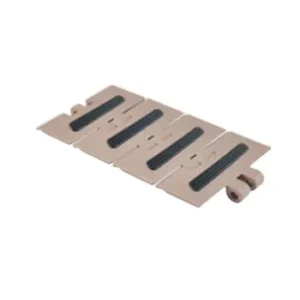
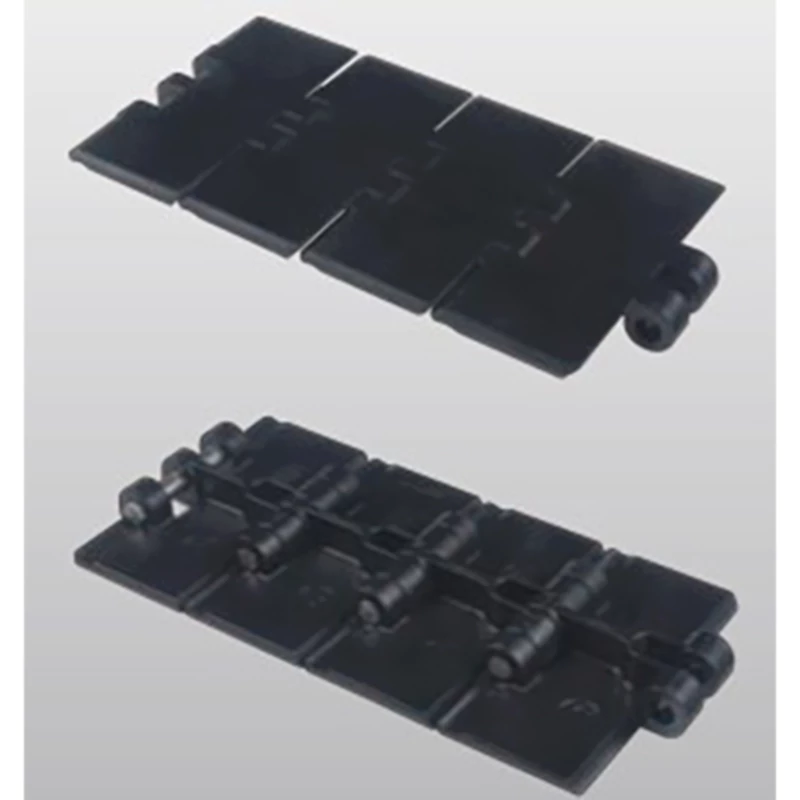
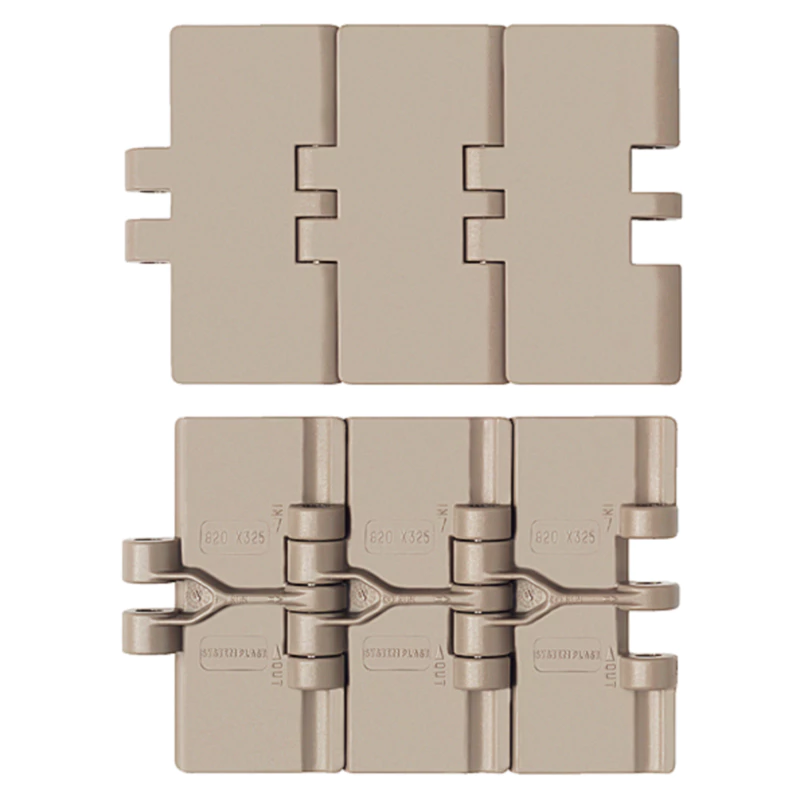
The LF820E is the anti-static (ESD) configuration of the LF820 flat top chain — the straight-running, single hinge standard pitch chain with carbon-black loaded POM compound providing surface resistivity in the electrostatic dissipative range. It is the standard specification for electronics assembly, PCB conveying, and pharmaceutical production lines where the straight-run transport sections must match the ESD performance of the sideflexing curve sections equipped with LF880TAB anti-static chain. Running standard POM chain on the straights and anti-static chain on the curves creates ESD-unprotected transition zones at every straight-to-curve boundary — the LF820E eliminates these zones, providing a consistent ESD surface across the full conveyor system. EverPower plastic chain Australia Pty Ltd supplies the LF820E as a direct replacement for System Plast 820E across widths K118 to K1200.
Operating parameters match the standard LF820 in every mechanical dimension: maximum straight run 12 m, maximum speed 60 m/min dry-run, 90 m/min lubricated, working load varies by width, operating temperature −40 °C to +90 °C, 25.4 mm pitch, SUS304 stainless steel connecting pins, 10 ft packing per box at 26 links per metre. Surface resistivity: 10⁴–10⁶ Ω/sq per EN 61340-5-1. Batch resistivity test certificates available on request. Learn more about EverPower’s quality and compliance capability at the About Us page.
The ESD Problem on Straight-Run Conveyor Sections
Static charge generation on conveyor chains is not limited to curved sections. A straight-run POM chain at 40 m/min on UHMWPE guide rails generates charge continuously through the entire contact length between chain body and guide rail. The charge accumulates on the chain surface because standard POM’s high resistivity (10¹²–10¹⁴ Ω/sq) prevents dissipation. Over a 10 m straight run at production speed, the accumulated surface charge density can reach 30–80 µC/m² depending on humidity, rail material, and chain speed — sufficient to generate visible sparking at the chain-to-product contact point when a new product is placed on the charged chain surface.
In electronics PCB assembly lines, this spark is the damage mechanism: PCB components placed on a charged chain surface experience a voltage transient at the point of chain contact. For through-hole components with leads contacting the chain surface, the transient propagates into the circuit. For surface-mount components sitting on the PCB topside, the charge induced on the board through capacitive coupling can be sufficient to damage gate oxides in transistors assembled in the previous station. The LF820E reduces chain surface charge density by approximately 85–90%, eliminating the spark at product placement and the voltage transient that follows.
LF820E Width Range and Key Parameters
| Width | Surface Resistivity | Max. Run | Max. Speed (dry) | Working Load | Packing |
|---|---|---|---|---|---|
| K118 | 10⁴–10⁶ Ω/sq | 12 m | 60 m/min | See LF820 datasheet | 10 ft / box |
| K190–K450 | 10⁴–10⁶ Ω/sq | 12 m | 60 m/min | See LF820 datasheet | 10 ft / box |
| K600–K750 | 10⁴–10⁶ Ω/sq | 20 m | 60 m/min | See LF820 datasheet | 10 ft / box |
| K1000–K1200 | 10⁴–10⁶ Ω/sq | 15 m | 50 m/min | See LF820 datasheet | 10 ft / box |
ESD Programme Integration: Matching Straight and Curve Chain
A complete ESD conveyor programme requires anti-static chain on every section of the conveyor that contacts product — both straight-run and curved sections. On a typical PCB assembly line with LF820E on straight sections and LF880TAB anti-static on curve sections, the programme is effective only if the grounding path from chain to earth is continuous across the straight-to-curve transition. The connecting link between the LF820E and the LF880TAB anti-static chain uses the same SUS304 stainless pin and POM link body as the standard chain, maintaining the ESD resistivity through the transition joint.
One installation detail that is frequently overlooked: the wear strip material in the guide rail must also be ESD-compatible. Standard UHMWPE wear strips are electrical insulators — if they electrically isolate the chain from the aluminium beam profile, the chain has no path to ground through the frame. Specify ESD-grade UHMWPE or conductive carbon-filled UHMWPE wear strips alongside the LF820E chain to maintain the complete dissipation path from chain surface through wear strip to aluminium beam to earth ground. EverPower supplies ESD wear strips on request.
Film Packaging and Pharmaceutical Applications
Beyond electronics, LF820E is specified in two other significant application categories in the Australian market. Flexible film packaging lines — producing polypropylene film bags, metallised snack packaging, and polyester film labels — generate high triboelectric charge on the film surface through the printing, cutting, and conveying process. When film contacts a standard POM chain, charge transfers from the film surface to the chain, and the accumulated chain charge then transfers to the next film piece placed on the chain. This charge-to-charge transfer causes film pieces to repel each other on the chain surface and causes film edges to stick to adjacent surfaces — both creating registration and stacking errors downstream. LF820E chain eliminates the charge accumulation mechanism, reducing film-to-chain charge transfer by 85–90%.
Pharmaceutical solid-dose manufacturing — tablet and capsule production — uses LF820E on inspection conveyor sections where tablets are presented individually to camera systems for dimensional and cosmetic inspection. Charged tablets on a standard POM chain develop adhesion to the chain surface (electrostatic adhesion, where a charged tablet is held to the oppositely charged chain). This adhesion is subtle but consistent enough to cause tablet spacing errors at the inspection station, degrading the camera system’s ability to inspect each tablet individually at rated throughput.
Matched Components EverPower Supplies
| Component | Description | Availability |
|---|---|---|
| LF820E Anti-Static Sprockets | Carbon-black POM or SUS304, all K-widths | ✓ On request |
| ESD Wear Strips (UHMWPE grade) | Conductive wear strips for ESD guide rail systems | ✓ On request |
| LF880TAB Anti-Static Sideflexing | ESD chain for curved sections of the same system | ✓ In stock |
| Standard LF820 Flat Top | Non-ESD sections or transitions on mixed systems | ✓ In stock |
What Our Customers Say
“LF820E throughout our PCB assembly conveyor — all straight sections matched with anti-static 880TAB on the curves. Latent gate-oxide failures that had been appearing at the rate of 1–2 per week dropped to zero within the first month. The ESD programme across the full conveyor system is what made the difference — partial coverage of only the curves was not sufficient.”
— Process Engineer, PCB Assembly, Sydney NSW
“LF820E K450 on our film inspection conveyor. Film edge sticking — which was causing approximately 0.8% of film pieces to stack incorrectly and jam the downstream folder — disappeared within three days of installation. We had been chasing the problem with ionising bars for 18 months. The chain was the source all along.”
— Production Supervisor, Flexible Packaging, Melbourne VIC
“Tablet inspection conveyor, LF820E K325. Spacing accuracy at the camera station improved from ±3 mm to ±0.8 mm after the ESD chain installation. The camera system’s throughput at rated speed is now achievable — previously we were running at 80% of rated speed to compensate for spacing error. The throughput recovery paid for the chain upgrade in under two weeks.”
— Manufacturing Engineer, Solid Dose Pharmaceuticals, Adelaide SA