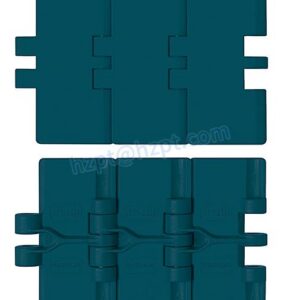
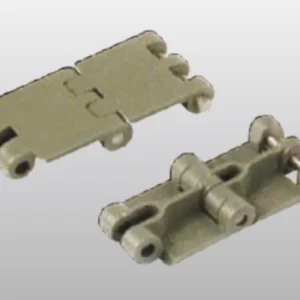
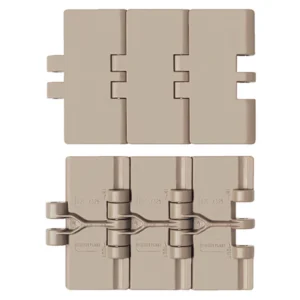
Description
Product Overview
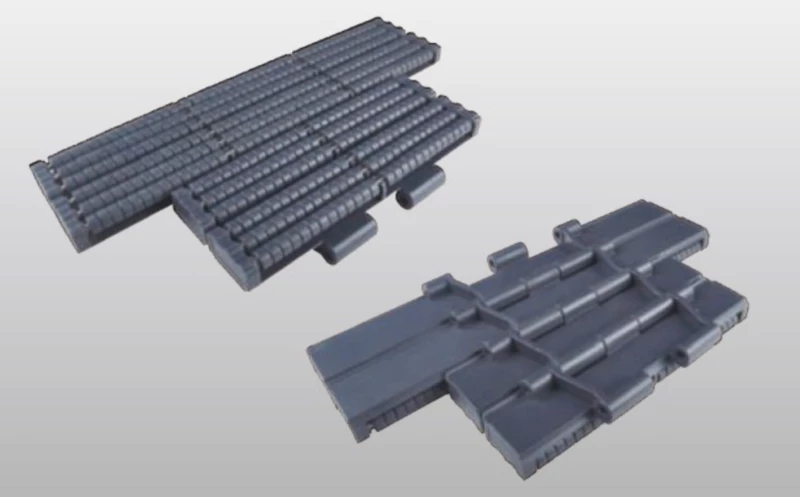
The LBP821-K750 is the entry width of the LBP821 double hinge roller accumulation chain series — the correct specification when accumulation zone width exceeds the single-hinge LBP831 maximum width of approximately 600 mm, or when product loads approach the single hinge design limit. The double hinge design (two SUS304 stainless pins per link joint rather than one) distributes transverse bending stress across two contact points, extending hinge bore service life by approximately 40–60% compared to single hinge chains at equivalent widths and loads. At K750, the LBP821 covers multi-file beverage accumulation (2–3 bottles side-by-side), wide carton accumulation, and multipack buffer zones ahead of secondary packaging. EverPower plastic chain Australia Pty Ltd supplies the LBP821-K750 as a direct replacement for System Plast LBP821 at K750 width.
Maximum conveyor run 12 m, working load 2,750 N, operating temperature -40 C to +90 C, 25.4 mm pitch, POM-C plate and roller material, SUS304 austenitic stainless steel pins. Packing: 5 ft (1.524 m) per box at 26 links per metre — the 5-foot box rather than the 10-foot box used for narrower chains reflects the higher weight per metre of the K750 double hinge chain, which makes the 10-foot box too heavy for practical handling. Visit the About Us page for supply information.
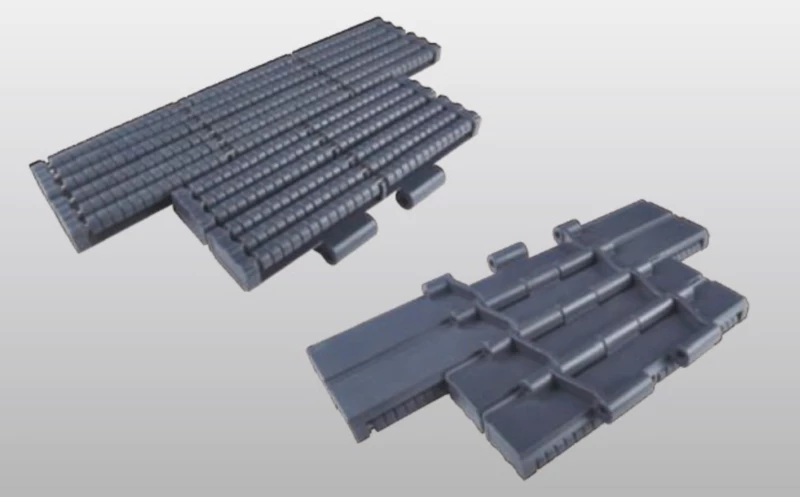
Technical Specifications — LBP821 at K750
| Parameter | Value |
|---|---|
| Chain series | LBP821 (double hinge, 821 chain body) |
| Width designation | K750 (750 mm) |
| Hinge type | Double, two SUS304 pins per link joint |
| Roller material | POM low-noise roller on POM axle boss |
| Back-pressure CoF | 0.01–0.02 |
| Back-pressure reduction vs flat top | ~90–95% |
| Max. conveyor run | 12 m |
| Working load | 2,750 N |
| Max. speed (dry) | 60 m/min |
| Operating temperature | -40 C to +90 C |
| Pitch | 25.4 mm |
| Links per metre | 26 |
| Packing | 5 ft / box (26 links/m) |
When K750 Double Hinge Replaces Single Hinge
The transition from single hinge (LBP831) to double hinge (LBP821) is driven by two independent thresholds, and either one alone justifies the upgrade. The first is chain width: above approximately 600 mm, the single hinge pin spanning the full chain width generates midspan bending stress that exceeds the POM hinge bore fatigue limit at rated product loads within 12–18 months. The double hinge at K750 reduces midspan stress by approximately 65% by distributing the load across two 375 mm half-spans rather than a single 750 mm span.
The second threshold is product load: at K600 or K750 with product loads above approximately 12 kg per metre of chain — typical for multi-file heavy glass bottle accumulation or for dense carton accumulation — the single hinge bore elongation rate accelerates to the point where replacement intervals shorter than 12 months become routine. The double hinge extends these intervals to 22–30 months at equivalent loads through the same stress distribution mechanism. At K750, both thresholds typically apply simultaneously: the width alone would justify double hinge, and the product loads at this format width generally reinforce the case.
Multi-File Beverage Accumulation at K750
The most common installation for LBP821-K750 in Australian beverage manufacturing is two-file (dual-lane) 600 ml PET bottle accumulation upstream of the packer. In this configuration, two parallel files of bottles (each file at approximately 80–100 mm centre-to-centre spacing) sit side-by-side on the 750 mm wide chain. The total product load is approximately 10–12 kg/m (two files at 5–6 kg/m each). On standard flat-top chain, a 4-metre accumulation zone at this load generates approximately 39–47 N of back-pressure — enough to tip bottles in the second file when they contact the downstream gate and are pushed laterally by the accumulated pressure.
LBP821-K750 reduces the back-pressure to 2–5 N across the same 4-metre zone, eliminating the tipping mechanism and allowing the accumulation zone to extend to its 12-metre maximum without product damage. This transforms a 4-metre accumulation buffer (approximately 40 bottles) into a 12-metre buffer (approximately 120 bottles) — tripling the buffer capacity and reducing the frequency of filler stoppages caused by downstream equipment outages by a corresponding factor.
Noise Performance on Wide Accumulation Zones
Wide accumulation zones generate more noise than narrow ones because the total chain surface area in sliding contact with accumulated product is larger, and the total lateral guide rail side force is higher. At K750 with 12 kg/m product load on a 6-metre accumulation zone, a standard flat-top chain generates accumulated sliding friction noise of approximately 74–78 dB(A) in the accumulation zone. The LBP821-K750 roller chain, by converting sliding to rolling contact, reduces this to approximately 67–70 dB(A) — a 7–8 dB(A) reduction that moves the accumulation zone from above to below the 72 dB(A) threshold for mandatory hearing protection under Safe Work Australia guidelines at typical operator dwell times.
Matched Components EverPower Supplies
| Component | Description | Availability |
|---|---|---|
| LBP821-K750 Double Hinge Sprockets | Roller-clearance tooth profile, K750-matched, double pin spacing | Stock on request |
| Replacement POM Rollers (K750) | LBP821-K750 roller and axle unit sets | Stock on request |
| LBP821-K1000 Wider Width | For wider multi-file accumulation on the same line | Stock on request |
| Standard LF821-K750 Double Hinge Flat Top | For transport sections upstream of accumulation | In stock |
What Our Customers Say
“LBP821-K750 dual-file 600 ml PET accumulation zone — 10 metres. We had been fighting tipping events in the second file for two years on standard flat-top chain. After roller chain installation: zero tipping in six months. The noise reduction was a bonus — that zone is now below our hearing protection threshold.”
— Line Supervisor, Beverage Production, Sydney NSW
“Hinge bore wear on K750 LBP831 single hinge was the reason we made the switch to LBP821 double hinge. At K750 with our product load, the single hinge was developing visible bore elongation by month 10. The double hinge LBP821 at 18 months shows bore wear within specification. The double hinge engineering case at this width is solid.”
— Maintenance Engineer, FMCG Packaging, Melbourne VIC
“The 5-foot box packing at K750 is a practical detail that matters on the warehouse floor — the 10-foot box would be too heavy to move safely on our installation. EverPower supplies the correct packing for the chain width without being asked. That kind of product knowledge in the supply chain reduces handling errors.”
— Logistics Manager, Beverage Facility, Brisbane QLD