Description
Product Overview
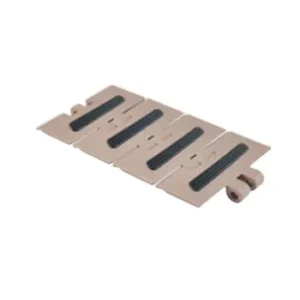
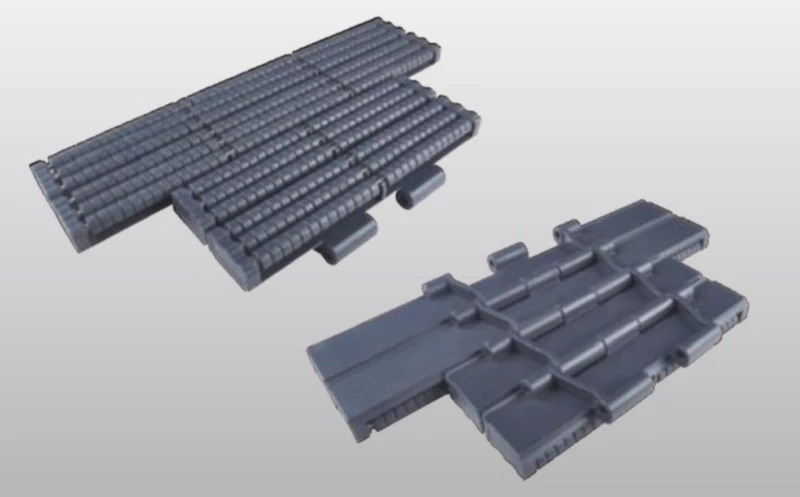
The LBP821-K1000 is the 1,000 mm width variant of the LBP821 double hinge roller accumulation chain — the standard specification for wide-format multi-file accumulation zones in high-throughput beverage, can, and carton packaging lines. At 1,000 mm chain width, the accumulation zone carries three to five product files simultaneously, creating a buffer capacity per metre of chain that is 3–5 times greater than an equivalent single-file K325 or K450 installation. This high buffer density per metre of conveyor is the primary engineering driver for specifying K1000 rather than multiple parallel K325 or K450 chains: a 10-metre K1000 accumulation zone replaces what would otherwise be five parallel 10-metre K200 chains with five separate drives — a significant simplification of the conveyor system architecture and maintenance load. EverPower plastic chain Australia Pty Ltd supplies the LBP821-K1000 as a direct replacement for System Plast LBP821 at K1000 width.
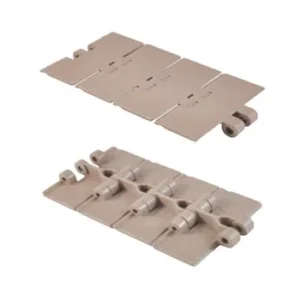
Maximum conveyor run 12 m, working load 2,750 N, pitch 25.4 mm, double hinge with SUS304 pins, POM-C plate and roller material, operating temperature -40 C to +90 C, packing 5 ft per box at 26 links per metre. The double hinge design is non-negotiable at K1000 — single hinge chains at 1,000 mm width develop measurable hinge bore elongation within 8–12 months at even moderate product loads, well below any acceptable maintenance interval for a production conveyor. Contact EverPower at the About Us page for project-specific support.
Technical Specifications — LBP821 at K1000
| Parameter | Value |
|---|---|
| Chain series | LBP821 (double hinge, 821 chain body) |
| Width designation | K1000 (1,000 mm) |
| Hinge type | Double, two SUS304 pins per link joint |
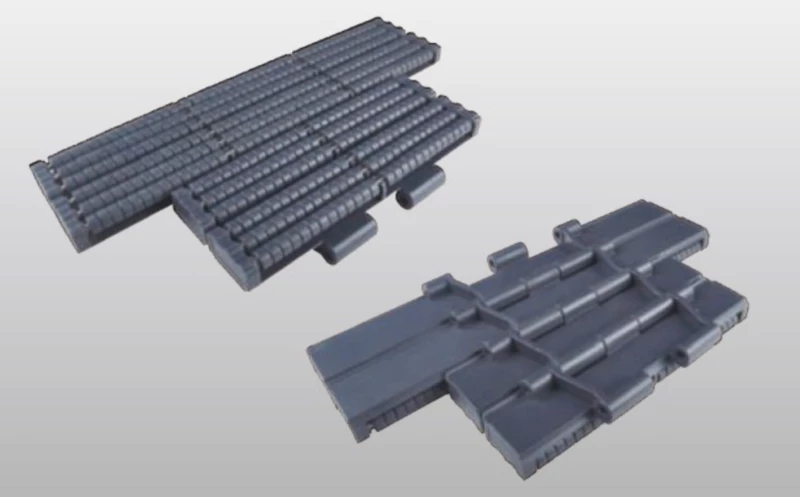
| Roller material | POM low-noise roller on POM axle boss |
| Back-pressure CoF | 0.01–0.02 |
| Back-pressure reduction vs flat top | ~90–95% |
| Max. conveyor run | 12 m |
| Working load | 2,750 N |
| Max. speed (dry) | 60 m/min |
| Operating temperature | -40 C to +90 C |
| Pitch | 25.4 mm |
| Links per metre | 26 |
| Packing | 5 ft / box (26 links/m) |
Multi-File Accumulation Architecture at K1000
A K1000 accumulation zone typically carries four files of 330 ml cans (80 mm diameter, 100 mm centre spacing, 4 files across 1,000 mm) or three files of 600 ml PET bottles (90 mm diameter, 110 mm centre spacing, 3 files across 1,000 mm). The total product load per metre of chain at these configurations is approximately 8–15 kg/m — within the LBP821-K1000 working load capacity when distributed across the 10-metre accumulation zone length, the chain tension at the tail drive is approximately 1,800–2,200 N, well within the 2,750 N working load.
The primary advantage of a K1000 roller chain over parallel narrow chains is that the four product files accumulate as a block — all four files experience the same drive speed, the same accumulation stop, and the same back-pressure environment simultaneously. With parallel narrow chains, each chain strand can develop slightly different tension due to minor speed variation between independently driven strands, causing one file to advance relative to others and creating cross-file misalignment that can jam at narrowing conveyor sections downstream. The single K1000 roller chain eliminates this inter-file alignment problem entirely.
The Double Hinge Necessity at K1000
At K1000 width, the structural argument for double hinge is quantitative rather than precautionary. The transverse bending moment on a single hinge pin spanning 1,000 mm with a 15 kg/m product load at 25.4 mm pitch (giving approximately 3.8 N per link) is M = 3.8 x 1.0 / 4 = 0.95 N.m at midspan. POM hinge bore fatigue tests show that bore elongation of 0.5 mm (the replacement threshold) occurs at approximately 2.8 million articulation cycles at this bending moment — corresponding to less than 9 months at 60 m/min on a 1,000 mm chain. The double hinge reduces midspan bending moment to 0.95 / 4 = 0.24 N.m (two half-span pins), extending the same fatigue life calculation to approximately 36 months. The difference is a design lifetime, not a marginal improvement.
Noise Reduction at Wide Format: The Occupational Case
Wide accumulation zones at K1000 generate disproportionately high noise compared to narrow zones because the total chain surface area under sliding friction is large. A 6-metre K1000 accumulation zone at 60 m/min with 12 kg/m product load on standard flat-top chain generates approximately 78–82 dB(A) in the immediate zone — above the 80 dB(A) 8-hour TWA limit under the model WHS Regulations adopted in all Australian states. Worker rotations, mandatory hearing protection, and noise exposure records are required at these levels under AS/NZS 1269.0.
The LBP821-K1000 roller chain converts sliding to rolling contact across the full 1,000 mm chain width. Measured noise reduction in the K1000 accumulation zone is typically 7–10 dB(A), bringing a zone that measured 80–82 dB(A) to 70–75 dB(A) — below the 80 dB(A) 8-hour TWA limit for the majority of shift configurations. The noise reduction argument alone is sufficient to justify the LBP821-K1000 upgrade on a cost-benefit basis when comparing the roller chain premium against the ongoing cost of hearing protection programme administration, rotation scheduling, and medico-legal hearing monitoring documentation.
Matched Components EverPower Supplies
| Component | Description | Availability |
|---|---|---|
| LBP821-K1000 Double Hinge Sprockets | Roller-clearance, double-pin engagement, K1000-matched | Stock on request |
| Replacement POM Rollers (K1000) | LBP821-K1000 roller and axle unit sets | Stock on request |
| LBP8257-K1000 Heavy Duty | PA66 roller variant for heavier glass bottle loads | Stock on request |
| Standard LF821-K1000 Double Hinge Flat Top | For transport sections adjacent to accumulation | In stock |
What Our Customers Say
“LBP821-K1000 four-file can accumulation zone, 10 metres. Previously we had four parallel K200 roller chain strands with four drives. Single K1000 chain eliminated three drives, four gearboxes, and four control points. Maintenance load on the accumulation system dropped by approximately 75% in the first year. Simpler systems perform better.”
— Engineering Manager, Can Beverage Facility, Melbourne VIC
“We had K1000 flat-top chain accumulation at 82 dB in our noise survey — mandatory hearing protection and quarterly audiometric testing for three workers. After LBP821-K1000 roller chain: 73 dB. Two workers moved out of the mandatory protection category. That is a real reduction in our regulatory compliance cost and in the health risk to our people.”
— EHS Manager, Beverage Production, Sydney NSW
“Double hinge at K1000 is non-negotiable and the supplier who quoted us single hinge K1000 roller chain did not understand the application. EverPower specified double hinge correctly without being asked and explained the bending moment calculation when we queried it. Technical competence in the sales conversation is a reliable indicator of product quality.”
— Maintenance Planner, FMCG Production, Adelaide SA