Description
Product Overview
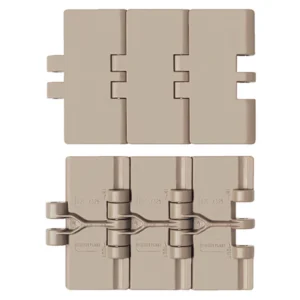
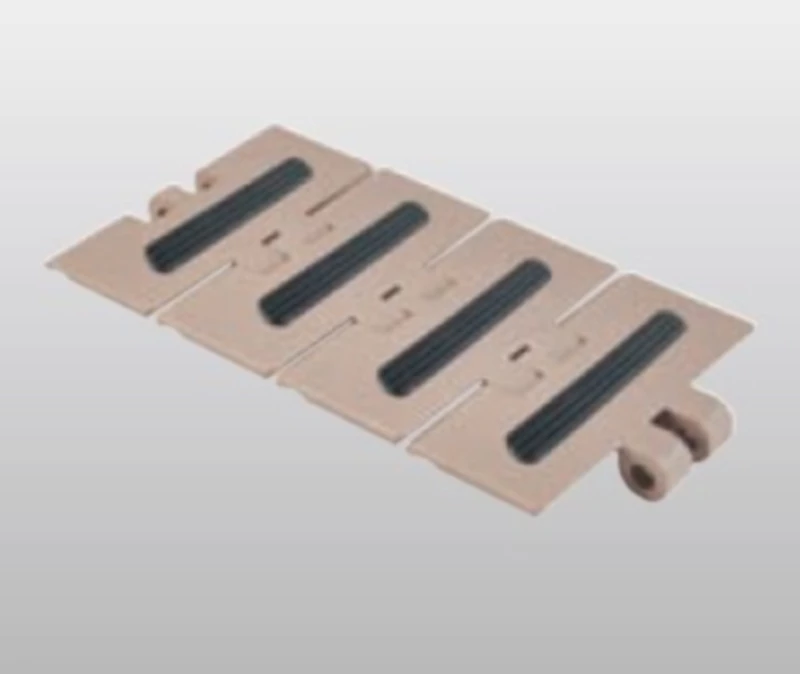
The LF820-K450G is the 450 mm width rubber-top flat top chain — part of the 820G single hinge series that adds a vulcanised rubber grip strip to the standard LF820 POM flat top chain to provide incline conveying capability and glass bottle surface protection without the product-contact damage associated with cleat chains. At K450 width, this chain is suited to the product format range that 450 mm covers — from small personal care bottles and standard 250 ml containers at the narrower widths, through standard 500 ml and 1 litre beverage formats at mid-widths, to wide multipacks and cases at the wider designations. EverPower plastic chain Australia Pty Ltd supplies the LF820-K450G as a direct replacement for System Plast 820-K450G.
Rubber strip compound: standard vulcanised SBR/NBR blend as standard, polyurethane on request. Coefficient of friction raised from approximately 0.20 (standard POM) to 0.50–0.60 (rubber strip). Maximum incline capability approximately up to 18 for standard beverage containers at rated speed. Operating temperature -20 C to +80 C (rubber strip constraint). Chain body: POM-C, -40 C to +90 C. SUS304 stainless steel pins. 25.4 mm pitch. 10 ft per box at 26 links per metre. Contact the EverPower team for polyurethane rubber option or custom configurations.
Technical Specifications — LF820-K450G
| Parameter | Value |
|---|---|
| Chain series | LF820G (single hinge, rubber-top) |
| Width designation | K450 (450 mm) |
| Rubber strip compound | Vulcanised SBR/NBR blend (PU on request) |
| Coefficient of friction (rubber on PET/glass) | 0.50–0.60 (SBR); 0.60–0.70 (PU) |
| Max. incline (standard containers) | Up to 20 degrees (load and format dependent) |
| Rubber strip temperature range | -20 C to +80 C continuous |
| Chain body temperature range | -40 C to +90 C |
| Max. speed (dry) | 60 m/min |
| Max. speed (lubricated) | 90 m/min |
| Pitch | 25.4 mm |
| Packing | 10 ft / box (26 links/m) |
K450 Width: Product Format Range and Application Fit
At 450 mm chain width, the LF820-K450G supports products with base diameters from approximately 90 mm to approximately 382 mm without excessive lateral overhang. This covers the primary product formats conveyed on rubber-top chains at this width in Australian food, beverage, and personal care manufacturing.
At K450, the rubber-top chain covers the broadest range of standard single-file beverage formats: 330 ml through 2 litre PET bottles, 330–500 ml cans, and 500 ml–1 litre glass bottles. This is the most common rubber-top width in Australian beverage manufacturing — it serves most single-file incline applications without being wider than necessary for the product range.
Why Rubber Top Instead of Cleat Chain for Inclined Sections
Cleat chains provide positive mechanical stops that prevent any back-slip on inclines, but the cleat face contacts the container at a fixed height. For glass bottles, this contact creates a stress concentration at the glass surface that causes chip marks — a cosmetic defect that triggers rejection at retailer DC receiving inspection. For PET bottles, cleat contact above the base creates squeeze marks on the sidewall when the accumulated product column pushes the upstream bottle against the cleat face of the downstream bottle.
Rubber-top chains achieve incline capability through surface friction rather than mechanical stops. The rubber surface contacts the entire container base uniformly, distributing the friction force across the full base area rather than concentrating it at a cleat face. For glass bottles, this eliminates the chip mark failure mode entirely. For PET bottles, the distributed contact pressure is well below the sidewall deformation threshold at inclines up to 20 degrees with standard container wall thicknesses. Where cleat chains were previously the only option, rubber-top chain is now the technically superior choice for all inclines below approximately 25 degrees.
Matched Components EverPower Supplies
| Component | Description | Availability |
|---|---|---|
| LF820-K450G Matched Sprockets | Rubber-top profile, matched to K450 width | In stock |
| Replacement Rubber Strips (K450) | SBR/NBR standard and PU variants | On request |
| Standard LF820 Flat Top (same width) | For flat transport sections adjacent to incline | In stock |
| LF821G Double Hinge Rubber Top | For wider incline sections above K600 | In stock |
What Our Customers Say
“LF820-K450G on our 15-degree incline transfer to the capper. Previously we used cleat chain and had chip mark rejections on glass — approximately 0.3% per shift. Rubber-top: zero chip marks in 8 months. The friction-based grip with no cleat face contact is clearly the right approach for glass.”
— Quality Manager, Glass Bottling, Melbourne VIC
“The rubber strip on the K450G holds our PET bottles at 14 degrees without back-slip at 45 m/min. We had tried POM flat-top chain on this incline first — product was sliding back at anything above 8 degrees. Rubber-top solved the incline grip problem in one change.”
— Line Engineer, Beverage Production, Adelaide SA
“Rubber strip service life at our duty cycle has been 24 months without replacement. The strip is vulcanised to the plate — no delamination, no peeling at the sprocket wrap. EverPower quality is consistent between orders.”
— Maintenance Planner, Food Manufacturing, Perth WA