Description
Product Overview
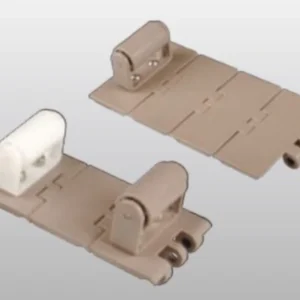
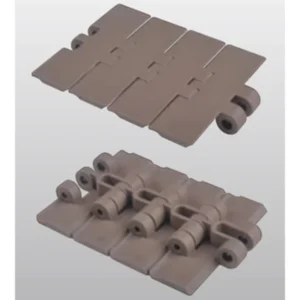
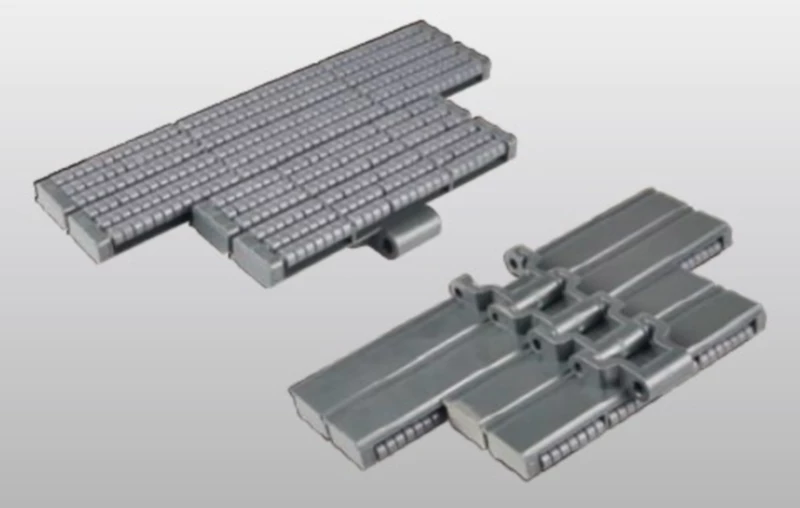
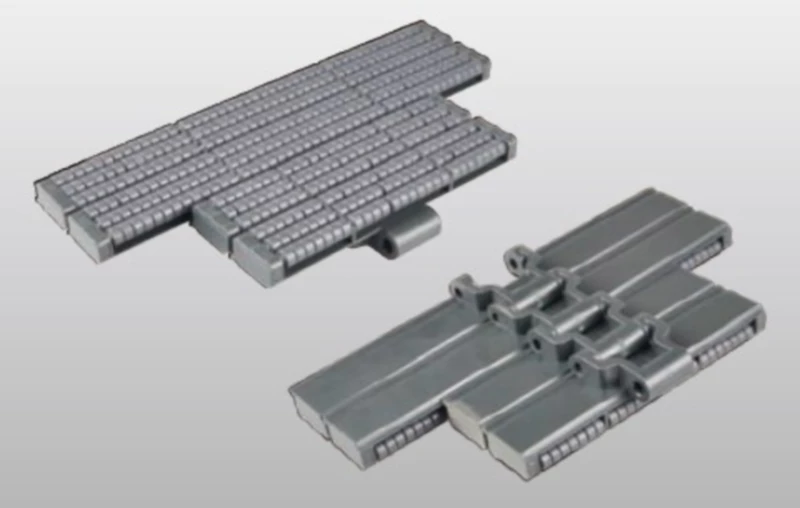
The LBP8257-K750 is the heavy-duty variant of the wide-format roller accumulation chain family, using PA66 (nylon 66) rollers rather than the standard POM rollers used in the LBP821 series. The PA66 compound has a higher compressive yield strength than POM — approximately 80–100 MPa versus 60–70 MPa for POM under sustained point load — which resists the flat-spotting failure mode that limits POM roller life under heavy product loads. At K750 width with glass bottle or dense can product loads above approximately 12–15 kg/m, POM rollers in the standard LBP821 series develop measurable flat-spotting within 8–12 months. PA66 rollers in the LBP8257 maintain their cylindrical profile for approximately 24–36 months under the same load conditions. EverPower plastic chain Australia Pty Ltd supplies the LBP8257-K750 as a direct replacement for System Plast LBP8257 at K750 width.
Maximum conveyor run 12 m, working load 2,750 N, operating temperature -40 C to +90 C, 25.4 mm pitch, SUS304 austenitic stainless steel pins, packing 5 ft per box at 26 links per metre. The LBP8257 uses a single hinge design at K750 — the same body structure as the LBP831, but with PA66 rollers. For K750 applications where hinge bore life is the primary concern (rather than roller life), the double hinge LBP821-K750 may be the more appropriate specification. Contact EverPower for a selection recommendation based on your specific product load and speed.
Technical Specifications — LBP8257 at K750
| Parameter | Value |
|---|---|
| Chain series | LBP8257 (heavy duty, PA66 rollers) |
| Width designation | K750 (750 mm) |
| Hinge type | Single hinge (heavy duty plate) |
| Roller material | PA66 reinforced roller — higher compressive yield strength |
| Back-pressure CoF | 0.01–0.02 |
| Back-pressure reduction vs flat top | ~90–95% |
| Max. conveyor run | 12 m |
| Working load | 2,750 N |
| Max. speed (dry) | 60 m/min |
| Operating temperature | -40 C to +90 C |
| Pitch | 25.4 mm |
| Links per metre | 26 |
| Packing | 5 ft / box (26 links/m) |
PA66 vs POM Rollers: The Material Engineering
POM and PA66 are both engineering polymers used in plastic conveyor chain components, but they have different strengths that make each suited to different load conditions. POM (polyoxymethylene, acetal) has a lower coefficient of friction, better dimensional stability in wet environments, and slightly better impact resistance at low temperatures. PA66 (nylon 66) has higher tensile strength, higher compressive yield strength, better resistance to sustained point loading (creep resistance), and better fatigue performance under cyclic load.
| Property | POM-C Roller | PA66 Roller | Practical Consequence |
|---|---|---|---|
| Compressive yield strength | ~60–70 MPa | ~80–100 MPa | PA66 resists flat-spotting under heavy loads |
| Coefficient of friction (dry) | 0.20–0.35 | 0.25–0.40 | POM has lower friction in standard conditions |
| Water absorption | <0.2% | 2.5–3.5% | POM dimensionally stable in wet; PA66 swells slightly |
| Creep under sustained load | Higher | Lower | PA66 maintains roller shape under sustained accumulation |
| Temp. range (continuous) | -40 C to +90 C | -40 C to +120 C | PA66 suits higher-temp pasteuriser-adjacent zones |
The critical selection variable is product load per roller contact point. A roller in a K750 chain with 14 kg/m product load at 25.4 mm pitch carries approximately 0.36 kg per roller at any instant during accumulation. This generates a contact stress at the roller-product interface that POM resists adequately at loads up to approximately 12 kg/m before flat-spotting accelerates. Above 12 kg/m — the load range typical of glass bottle accumulation at K750 — PA66 is the correct roller material selection. The LBP8257 with PA66 rollers is calibrated for exactly this application context.
When to Specify LBP8257-K750 Over LBP821-K750
Both chains are available at K750 and both use the same chain body width. The selection decision turns on which failure mode is the binding constraint for the specific application. The LBP821-K750 uses double hinge to address hinge bore wear at wide-format loads; its POM rollers are the limiting element at heavy glass bottle loads. The LBP8257-K750 uses PA66 rollers to address flat-spotting at heavy loads; its single hinge design may be the limiting element at very wide widths under sustained maximum load.
For wine bottle accumulation at K750 with 750 ml glass (typical product load 10–13 kg/m), the roller flat-spotting constraint arrives before the hinge bore constraint — PA66 rollers (LBP8257) are the correct specification. For PET bottle accumulation at K750 at 6–8 kg/m product load, the hinge bore constraint arrives before roller flat-spotting — double hinge POM roller (LBP821) is the correct specification. The crossover point is approximately 11–13 kg/m at K750; below this threshold, LBP821; above it, LBP8257.
Wine and Spirits Bottling: The Primary Application
Australian wine production processes approximately 1.8 billion litres per year, with a significant proportion bottled in glass at 750 ml. The accumulation zones on wine bottling lines — between the filler and the capsule applicator, between the labeller and the cartoniser, and between the cartoniser and the pallet builder — all carry glass bottle loads that are among the heaviest standard product loads in the food manufacturing sector. LBP8257-K750 is the standard specification for these zones in Australian wine bottling facilities that have recognised the POM roller flat-spotting problem and upgraded to heavy-duty PA66 roller chain.
Spirits bottling presents an even more demanding case: 700 ml spirits bottles typically weigh 1.6–2.0 kg full (glass accounts for approximately 600–800 g of this, with heavier spirits bottles being a marketing differentiator). At K750 with 3 files of 700 ml spirits bottles at 0.12 m centre-to-centre spacing, the product load is approximately 14–17 kg/m — at the upper range of the LBP8257 specification. EverPower recommends a full tension and roller load calculation for spirits bottling applications at K750 before confirming the LBP8257 specification.
Matched Components EverPower Supplies
| Component | Description | Availability |
|---|---|---|
| LBP8257-K750 Sprockets | PA66 roller-clearance tooth profile, K750-matched | Stock on request |
| Replacement PA66 Rollers (K750) | Heavy-duty roller and axle unit sets | Stock on request |
| LBP821-K750 Double Hinge POM Roller | For lighter product loads where hinge bore is the constraint | In stock |
| LBP8257-K1000 Wider Width | Heavy duty PA66 roller at wider format | Stock on request |
What Our Customers Say
“LBP8257-K750 PA66 roller chain on our 750 ml wine bottle accumulation zone. Standard LBP821 POM rollers were flat-spotting by month 9 at our product load. PA66 rollers in LBP8257: 20 months in, roller surface still cylindrical within specification. The load calculation EverPower ran confirmed we were above the POM threshold — the PA66 specification was correct.”
— Maintenance Engineer, Wine Bottling, Hunter Valley NSW
“Spirits line accumulation — 700 ml premium glass at 16 kg/m product load. EverPower ran the roller contact stress calculation before we ordered. The PA66 roller was the only option that gave a service life above 18 months at this load. Running at 22 months, rollers within specification. The engineering approach to product selection is what differentiates EverPower from catalogue suppliers.”
— Plant Engineer, Spirits Bottling, Melbourne VIC
“We evaluated both LBP821 (POM roller) and LBP8257 (PA66 roller) at K750 for our wine line. The product load put us at 12.5 kg/m — right at the boundary. EverPower recommended LBP8257 at this load level. We followed the recommendation. Two seasons in without a roller replacement — the right call.”
— Production Manager, Winery Bottling, Barossa SA