Description
Product Overview
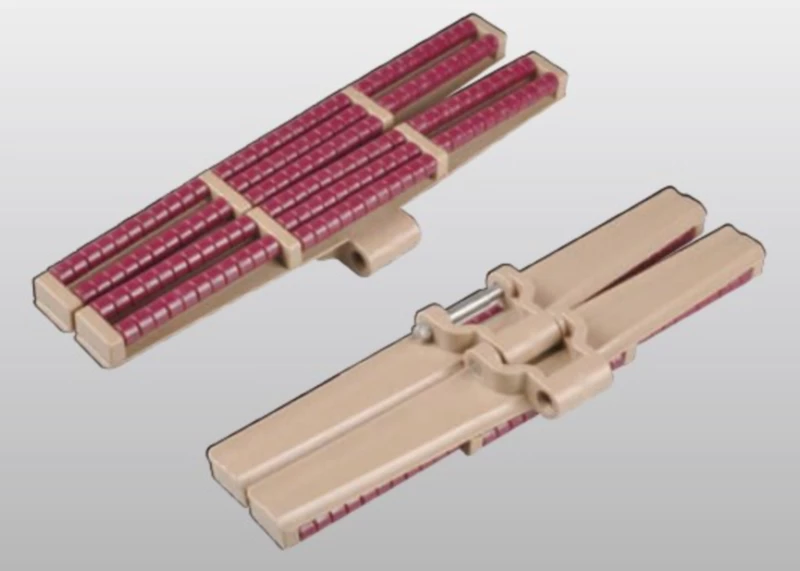
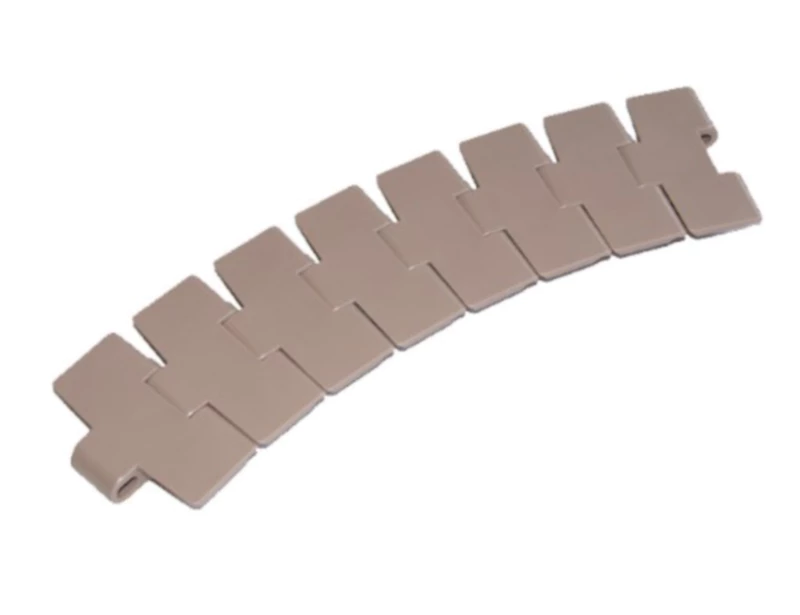
The LBP882M-K1000 is the 1000 mm width variant of the LBP882M sideflexing magnetic roller accumulation chain — a specialist product that combines three advanced chain technologies simultaneously: sideflexing capability for horizontal curve navigation, embedded rare-earth magnets for ferrous product retention, and POM low-noise rollers for back-pressure reduction during accumulation. No single one of these features is common in isolation; all three together make the LBP882M the correct specification for can and tinplate product accumulation zones that include horizontal curves, where standard magnetic chains cannot accumulate without back-pressure damage and standard roller chains cannot navigate the curve without losing product. EverPower plastic chain Australia Pty Ltd supplies the LBP882M-K1000 as a direct replacement for System Plast LBP882M at K1000 width.
Working load 2,750 N, maximum run 12 m, bevel-edge sideflexing, NdFeB magnets embedded in each link body, ferritic stainless steel pins for magnetic circuit optimisation, POM rollers projecting above each link plate, operating temperature -40 C to +80 C (magnet Curie limit), 25.4 mm pitch, 5 ft per box at 26 links per metre. Contact the EverPower Sydney team for magnetic retention force confirmation at your operating gap.
Technical Specifications — LBP882M at K1000
| Parameter | Value |
|---|---|
| Chain series | LBP882M (sideflexing, magnetic, roller accumulation) |
| Width designation | K1000 (1000 mm) |
| Curve capability | Bevel edge sideflexing, min. inner radius ~600–800 mm (width-dep.) |
| Magnet type | NdFeB rare-earth, embedded per link |
| Magnet holding force | ~10–14 N per magnet link at 2 mm gap |
| Pin material | Ferritic stainless steel (magnetic circuit optimised) |
| Roller material | POM low-noise roller on POM axle boss |
| Back-pressure CoF (rolling) | 0.01–0.02 |
| Max. conveyor run | 12 m |
| Working load | 2,750 N |
| Max. speed (magnetic retention) | ~40 m/min (centrifugal force constraint at curve) |
| Operating temperature | -40 C to +80 C (NdFeB Curie point limit) |
| Pitch | 25.4 mm |
| Packing | 5 ft / box (26 links/m) |
Why Three Technologies Are Needed Simultaneously
Standard magnetic sideflexing chains (LF880M series) can navigate curves and retain ferrous product through those curves — but when product accumulates on the chain, sliding back-pressure builds up exactly as it does on standard flat-top chains. For an accumulation zone before a can seamer or a tinplate lid stacker, this sliding back-pressure can cause cans to tip or stack incorrectly in the accumulated column. Standard roller chains eliminate back-pressure but cannot retain product through curves. The LBP882M-K1000 solves both problems by integrating all three capabilities in a single chain that retains cans through curves (magnetic), accumulates without tipping (roller), and navigates curved accumulation buffer layouts (sideflexing).
At K1000 width, the LBP882M typically carries 12–14 files of standard 73 mm diameter cans (330 ml or 440 ml format). The magnetic holding force of 10–14 N per link at 2 mm gap exceeds the centrifugal force generated by the can mass through the minimum bend radius at speeds up to 40 m/min — verified through the centrifugal force calculation F = m x v squared / r, where m is can mass, v is line speed, and r is curve inner radius.
Can Manufacturing Application Context
The LBP882M is primarily specified on can filling and secondary packaging lines where the conveyor path from filler to accumulation buffer includes one or more horizontal curves. Without the LBP882M, the standard approach requires a straight accumulation buffer spur with divert gate, format-specific guide rails on the curve, and remerge gate at the buffer exit — adding capital cost, maintenance items, and jam points. The LBP882M allows the accumulation zone itself to follow the curve, eliminating the spur layout and its associated hardware.
At K1000 width, the LBP882M can carry multi-file can accumulation through a curved buffer section. The absence of side guide rails at the curve — replaced by magnetic retention — means format changes between can heights and diameters require no conveyor adjustment at the curve section. On a line changing between 330 ml and 500 ml can formats, the LBP882M curve sections are format-independent.
Matched Components EverPower Supplies
| Component | Description | Availability |
|---|---|---|
| LBP882M-K1000 Curve Sprockets | Non-magnetic, roller-clearance, bevel curve profile | Stock on request |
| LF880M Standard Magnetic Sideflexing | For non-accumulation curve sections on the same line | In stock |
| LBP882TAB-K1000 Roller Sideflexing | Non-magnetic roller curve chain if magnets not needed | Stock on request |
| Standard LF882 Wide Sideflexing | For straight sections of the same wide-format system | In stock |
What Our Customers Say
“LBP882M-K1000 on our can filling line curved accumulation buffer. The combination of magnetic retention and roller accumulation in one chain eliminated the divert-spur-remerge layout we had originally designed. Simpler system, fewer drive motors, and no format-specific guide rail adjustments at the curve section.”
— Conveyor Systems Engineer, Can Beverage Facility, Sydney NSW
“The magnetic retention holds cans through the 90-degree curve at 38 m/min without any lateral guide. Format changeover between 330 ml and 500 ml at the curve section: zero adjustment required. Previous format change time at that section was 18 minutes. Now it is zero.”
— Production Manager, Can Filling, Melbourne VIC
“We needed confirmation that the magnetic force exceeded centrifugal force at our 35 m/min line speed and 650 mm inner radius before we specified. EverPower provided the calculation. The safety margin was adequate. The chain has run 11 months and held every can through the curve at line speed.”
— Mechanical Engineer, Beverage Canning, Brisbane QLD