Description
Product Overview
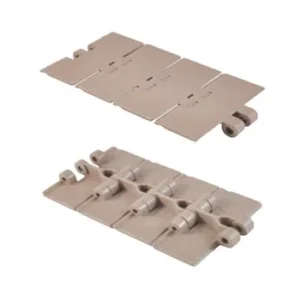
Rubber-top flat top chains add a vulcanised rubber or polyurethane grip layer to the standard POM flat top chain surface, raising the coefficient of friction from approximately 0.15–0.25 to 0.50–0.70 depending on the rubber compound and the product material. This friction increase enables conveying on inclined sections without cleat chains, prevents back-slip of heavy products in stopped-motion accumulation, and protects fragile glass and ceramic containers from surface marking that standard POM-on-product contact would cause. The four primary rubber-top variants — 820G (single hinge straight), 821G (double hinge straight), 880TAB-G (sideflexing single hinge), and 882TAB-G (wide sideflexing double hinge) — cover the full range of width, hinge type, and curve capability requirements. EverPower plastic chain Australia supplies all four as direct replacements for System Plast equivalents.
Rubber-top chains address a gap that neither standard flat-top nor cleat chains fill cleanly: gentle inclines (5–25°) with fragile, heavy, or irregularly based products where cleats would cause product contact damage and standard flat-top surface friction is insufficient to prevent back-slip. They are also the standard specification for conveyor sections immediately adjacent to glass filling lines, where preventing glass-on-POM surface scratching is a non-negotiable quality requirement. Learn more at the About Us page.
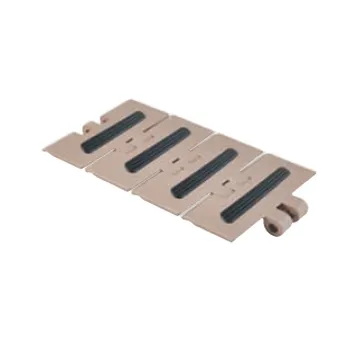
Rubber-Top Variant Matrix
| Variant | Base Chain | Hinge | Flex Capability | Width Range | Primary Application |
|---|---|---|---|---|---|
| 820G | LF820 | Single | Straight run | K325 to K750 | Light incline, glass bottle conveying |
| 821G | LF821 | Double | Straight run | K750 to K1200 | Wide incline, heavy multipack, wine/spirits |
| 880TAB-G | LF880TAB | Single | Sideflexing (~400 mm) | K325 to K600 | Inclined curves, tight-radius incline sections |
| 882TAB-G | LF882TAB | Double | Sideflexing (~450 mm) | K600 to K1200 | Wide inclined curves, case and multipack |
Rubber Compound Options: Standard vs Polyurethane
Two rubber compound types are available across the rubber-top chain range, each suited to different product contact and environment conditions.
Standard Vulcanised Rubber (SBR/NBR blend)
The standard rubber strip compound provides a surface hardness of approximately 50–60 Shore A and a coefficient of friction of 0.50–0.60 against glass, PET, and most carton board surfaces. It is resistant to water, dilute cleaning agents, and mild acids (pH 4–9). Temperature range is −20 °C to +80 °C continuous. This is the standard specification for most beverage and food conveyor incline and grip applications in Australia. The rubber strip is vulcanised (chemically bonded) to the POM chain top plate — it does not peel or delaminate under normal conveying loads, and the bonded interface withstands the flexing stresses that occur when the chain wraps around the drive and tail sprockets.
Polyurethane Rubber (PU)
Polyurethane rubber strips provide a harder surface (70–80 Shore A) with a coefficient of friction of 0.60–0.70 — approximately 15–20% higher than the standard compound. PU also has significantly better abrasion resistance, making it the preferred choice for applications where the rubber surface contacts rough corrugated cardboard, abrasive product packaging, or textured ceramic surfaces. PU resists oils and lubricants better than SBR blends, and is the specification of choice for food-zone incline conveyors where H1 lubricant spray from adjacent sections may contact the chain surface. PU is not suitable for environments with aromatic solvents or concentrated ketones.
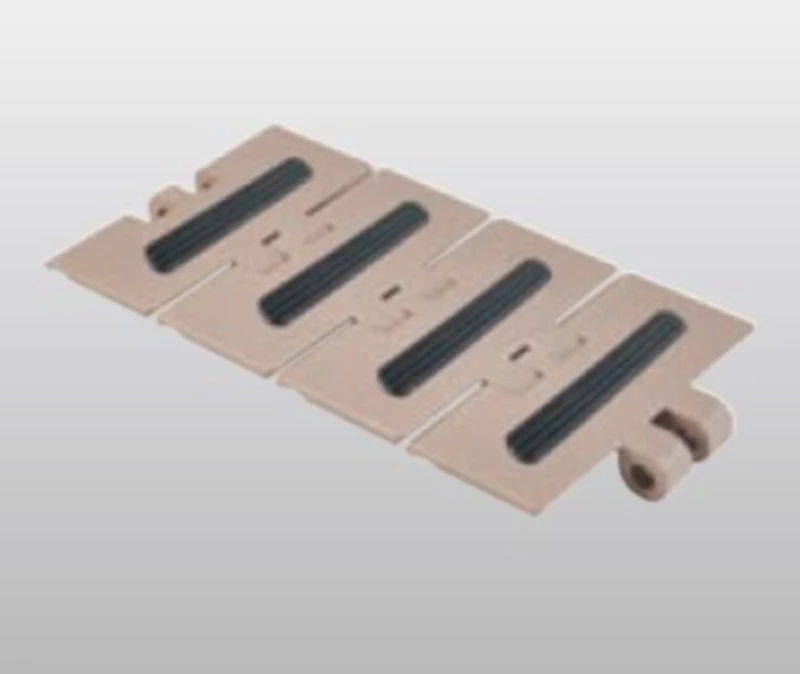
820G: Single Hinge Straight Rubber Top — Width-by-Width Selection
The 820G series is the most commonly specified rubber-top chain in Australian food and beverage manufacturing, covering widths from K325 to K750. It replaces the standard LF820 flat-top chain on any section where a grip surface is required — typically inclined sections from 5° to 20°, glass bottle transfer sections where surface marking is a quality concern, and accumulation zones where heavy product weight combined with standard POM surface friction would cause unacceptable back-pressure on a straight flat-top chain.
| Width | Chain No. | Rubber Strip Pattern | Typical Incline Capacity |
|---|---|---|---|
| K325G | LF820-K325G | Continuous strip | Up to 20° with 500 ml PET |
| K350G | LF820-K350G | Continuous strip | Up to 18° with standard bottle |
| K400G | LF820-K400G | Continuous strip | Up to 18° with carton |
| K450G | LF820-K450G | Continuous strip | Up to 18°, most beverage applications |
| K600G | LF820-K600G | Continuous strip | Up to 15° with case/multipack |
| K750G | LF820-K750G | Continuous strip | Up to 15° with wide multipack |
821G: Double Hinge Wide Rubber Top for Heavy Loads
The 821G extends rubber-top capability to the double hinge 821 chain body, covering widths from K750 to K1200. The double hinge design is essential at these widths — on a K1000 or K1200 rubber-top chain carrying a full row of 12-packs or heavy glass bottles, the transverse load on each hinge pin is substantial. Single hinge pins at these widths develop measurable bore elongation within 12 months under this loading; the double hinge 821G distributes the load across two pin-to-bore contact points, extending service life to 24–36 months at equivalent loads.
821G at K1200 is the standard specification for Australian wine and spirits distribution centre incline conveyors carrying 12-bottle cases (approximately 15 kg per case) at 5–12° incline. The rubber strip provides sufficient friction to hold the case on the incline without back-slip, while the POM chain body beneath the rubber layer provides the structural stiffness to support the case weight across the full chain width without sag. No cleat or physical stop is required on inclines up to approximately 12° with this product weight.
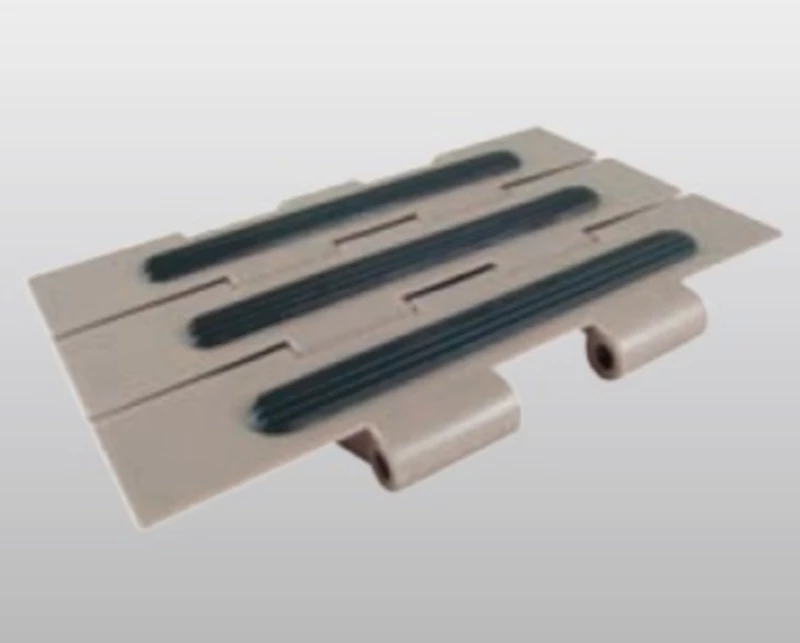
880TAB-G and 882TAB-G: Rubber Top on Sideflexing Chains
The 880TAB-G and 882TAB-G add rubber-top grip to the tab-link sideflexing chain bodies — the same chain families used in the LF880TAB and LF882TAB standard flat-top sideflexing products. These variants are specified for inclined curved conveyor sections where product must be retained both laterally (against centrifugal force through the curve) and longitudinally (against back-slip on the incline). Standard sideflexing chains provide neither; rubber-top sideflexing chains provide both simultaneously.
The 880TAB-G covers widths from K325 to K600 with a minimum inner bend radius of approximately 400 mm and incline capability up to approximately 15°. The 882TAB-G covers K600 to K1200 with minimum inner radius of approximately 450 mm and equivalent incline rating. Both maintain full rubber-strip integrity through the curve — the rubber strip is bonded to each individual link plate rather than spanning across links, ensuring it does not delaminate or crack when the chain flexes laterally through the minimum bend radius.
Matched Components EverPower Also Supplies
| Component | Description | Availability |
|---|---|---|
| Rubber-Top Sprockets (820G / 821G) | Matched to rubber-top chain tooth profile, all widths | ✓ On request |
| 880TAB-G / 882TAB-G Curve Sprockets | Inner/outer curve, all K-widths | ✓ On request |
| Replacement Rubber Strip Sets | Standard SBR and polyurethane, all widths | ✓ On request |
| Standard LF820 / LF821 Flat Top | For non-incline sections of the same conveyor line | ✓ In stock |
What Our Customers Say
“820G K450 on a 14° incline conveying 1.25 litre PET bottles. Before rubber top we needed a cleat chain at this angle, which caused bottle-neck marking at the cleat contact. Rubber top holds the bottle without any contact above the base — zero marking incidents in nine months.”
— Maintenance Engineer, Beverage Bottling, Adelaide SA
“821G K1200 on our wine case incline — 12-bottle Shiraz cases at 8°. The double hinge handles the full case weight across 1.2 metres of chain width without any visible sag or hinge distortion. We inspected the hinge bores at 18 months and they are within specification. A solid product.”
— Plant Engineer, Wine Production, Barossa Valley SA
“882TAB-G K750 on a curved incline in our dairy distribution centre. The combination of grip and curve capability in a single chain simplified our conveyor layout significantly — no separate straight incline followed by a curve unit. One chain, one drive, fewer maintenance items.”
— Distribution Centre Engineer, Dairy Logistics, Sydney NSW