Description
Product Overview
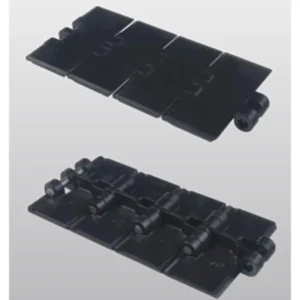
The LF882TAB combines the two defining capabilities of the upper 880-family range: the wide-format reinforced link plate of the 882 series and the tab-link sideflexing geometry of the TAB variants. Where the LF882 bevel achieves wide-format curve stability at radii above approximately 750–1,200 mm (depending on width), the LF882TAB extends that capability to tighter curves — typically achieving minimum inner radii approximately 30–40% smaller than the equivalent 882 bevel configuration. This makes it the correct specification for wide-format distribution centre and case conveyor layouts that include tight merge curves, U-turns within constrained floor space, or elevated spiral sections where the curve radius is dictated by the building structure rather than the conveyor designer. EverPower plastic chain Australia Pty Ltd supplies the LF882TAB as a direct replacement for System Plast 882TAB across widths K600 to K1200.
Operating parameters: maximum chain tension 3,000 N, maximum straight run 9 m, maximum speed 60 m/min dry-run and 90 m/min lubricated, operating temperature −40 °C to +90 °C, 25.4 mm pitch, POM-C plate material, SUS304 stainless steel pins. Standard packing 10 ft per box at 26 links per metre. The LF882TAB-G rubber-top variant adds vulcanised rubber grip strips for inclined curve sections; width-specific rubber-top product images for K600G through K1200G are shown in the companion product pages. Visit the About Us page for EverPower’s supply and quality information.
882TAB vs 882 Bevel: When the Tighter Radius Is Worth the Complexity
The LF882 bevel achieves its minimum curve radius through the bevelled outer corner of each link plate — a fixed-geometry approach that sets a minimum radius floor determined by the bevel angle and the chain width. For K750, this floor is approximately 900–1,000 mm. For K1000, it rises to approximately 1,200–1,400 mm. In most new-build distribution centre conveyor designs, the layout architect can accommodate these radii by planning around them. The LF882TAB becomes necessary when the floor is already built and the structural column positions, floor penetrations, or wall offsets make the bevel minimum radius unachievable in the available space.
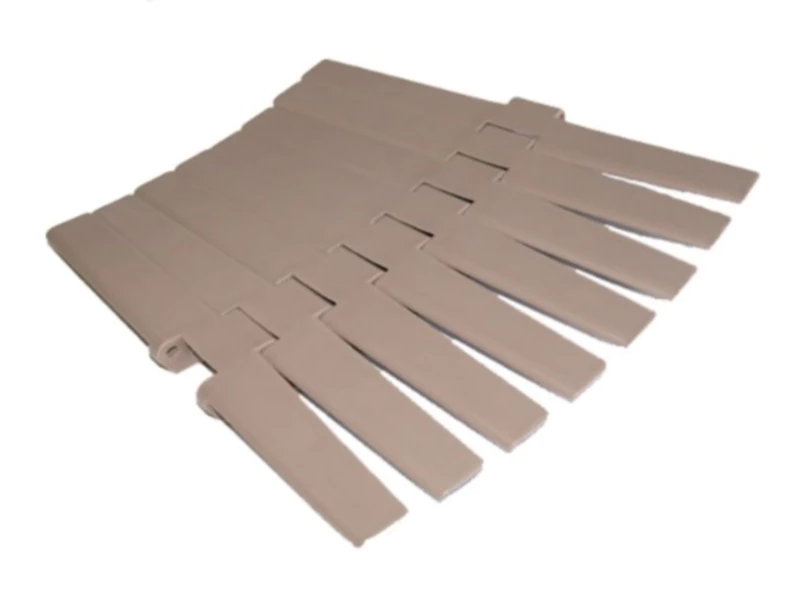
The tab-link geometry of the LF882TAB inserts narrower-profile tab links at regular intervals, creating flex relief zones that allow greater lateral deflection per link. At K750, the LF882TAB typically achieves approximately 650–750 mm minimum inner radius — roughly 30% tighter than the equivalent bevel LF882. At K1000, approximately 850–950 mm versus 1,200–1,400 mm for the bevel. These are meaningful differences in constrained layouts: a reduction of 350–450 mm in required curve corridor width at K1000 can mean the difference between the conveyor fitting within the building envelope and requiring structural modification.
Width-Specific Performance Summary
| Width | Min. Inner Radius (882TAB) | Min. Inner Radius (882 Bevel) | Radius Saving | Typical Application |
|---|---|---|---|---|
| K600 | ~550–650 mm | ~750–850 mm | ~200 mm | Wide-format merge curve, moderate radius |
| K750 | ~650–750 mm | ~900–1,000 mm | ~250 mm | Case conveyor merge, constrained DC layout |
| K1000 | ~850–950 mm | ~1,200–1,400 mm | ~350–450 mm | High-capacity wide-format, structural-constrained curve |
| K1200 | ~1,000–1,100 mm | ~1,400–1,600 mm | ~400–500 mm | Maximum-width sideflexing, tight building envelope |
Case Conveying at Wide Format: Load Management
The LF882TAB’s 3,000 N working load — matching the LF882 bevel — reflects the reinforced link plate construction shared between the two variants. At K1000 width conveying standard retail grocery cases (approximately 12–18 kg per case, 3–4 cases across the chain width at any instant), the chain tension calculation at rated load over a 9 m straight run approaches 1,800–2,200 N depending on the chain-to-rail friction coefficient and the inclination of the straight section. This is comfortably within the 3,000 N working load, providing a safety factor of approximately 1.4–1.7 that accounts for dynamic load spikes from product impact at conveyor entry points and tension transients at drive start-up.
On the curved sections, the outer radius guide rail side force adds to the chain tension locally. At K1000, 30 m/min, and 15 kg/m product load, this additional side-force tension component is approximately 300–500 N on a 90° curve with 1,000 mm inner radius — increasing the local chain tension to approximately 2,100–2,700 N. Still within the 3,000 N rating, but close enough that the tension calculation should be performed explicitly for the curve section before finalising the design. EverPower provides tension calculation assistance for wide-format curved conveyor projects on request.
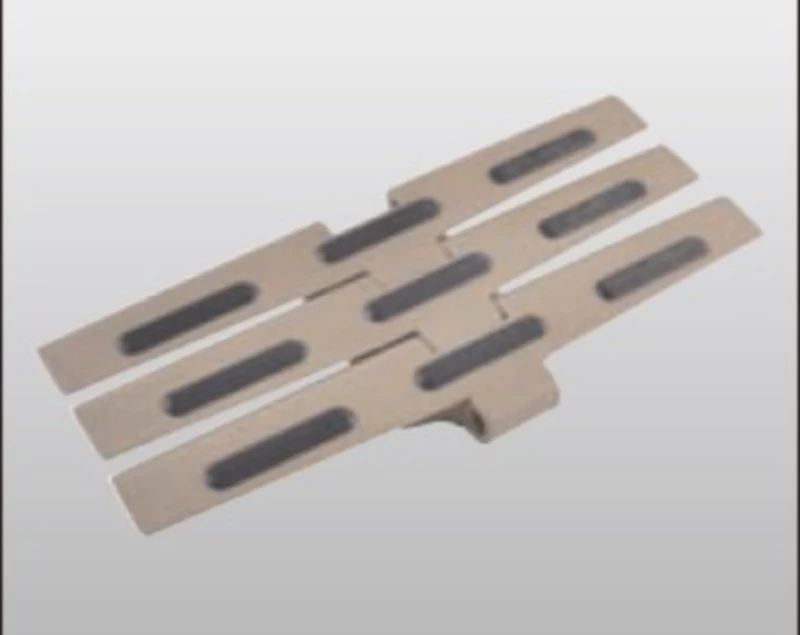
LF882TAB-G: Rubber Top for Wide Inclined Curves
The LF882TAB-G adds vulcanised rubber grip strips to the standard LF882TAB link plates, raising the coefficient of friction from approximately 0.20 to 0.55–0.65. At K600–K1200 widths, this rubber-top capability is specified for wide-format inclined merge curves — a configuration found in multi-level distribution centres where a conveyor must simultaneously curve horizontally and rise vertically to reach a mezzanine packing level. The combined challenge of centrifugal lateral force (from the horizontal curve) and gravitational back-slip (from the incline) requires both the lateral stiffness of the 882 wide-format body and the grip of the rubber-top surface.
For inclines up to approximately 12° with standard retail case weights, the LF882TAB-G provides stable conveying through combined inclined-curve sections without supplementary pusher devices or overhead hold-down mechanisms. Above 12° at K1000–K1200 widths with maximum case loads, contact EverPower’s technical team with the specific incline angle, case weight, and curve radius for a confirmed grip force calculation.
Matched Components EverPower Supplies
| Component | Description | Availability |
|---|---|---|
| LF882TAB Curve Sprockets (wide format) | Inner/outer radius, all K600–K1200 widths | ✓ On request |
| LF882TAB-G Rubber Top Chain | Grip surface K600–K1200, all widths in stock | ✓ In stock |
| LF882 Bevel Sideflexing | For wider-radius curves on the same conveyor system | ✓ On request |
| LF821 Double Hinge Straight | For straight sections of the same wide-format system | ✓ In stock |
What Our Customers Say
“LF882TAB K1000 on a 90° merge curve constrained by a structural column at 950 mm inner radius. The LF882 bevel would have required 1,300 mm minimum — we would have had to relocate the column. LF882TAB at 950 mm inner radius solved the layout problem without any structural work. Running 12-bottle wine cases at 28 m/min without a single tip event in 9 months.”
— Distribution Centre Engineer, Wine Logistics, Barossa Valley SA
“882TAB-G K750 on a combined incline-and-curve section at our grocery DC mezzanine approach. 10° incline and 700 mm inner radius simultaneously. The rubber top prevents back-slip on the incline; the tab-link achieves the curve radius. No other single chain met both requirements. EverPower confirmed the grip force calculation before we specified — they were right.”
— Conveyor Systems Manager, Grocery Distribution, Sydney NSW
“K1200 LF882TAB on our widest merge curve. We had tried a parallel two-strand approach with K600 chains — the strands tracked differently on the curve and created a surface misalignment. 882TAB single-strand eliminated the alignment issue entirely and simplified the drive arrangement to one motor instead of two.”
— Engineering Manager, FMCG Fulfilment Centre, Melbourne VIC