Description
Product Overview
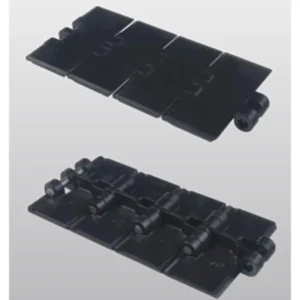
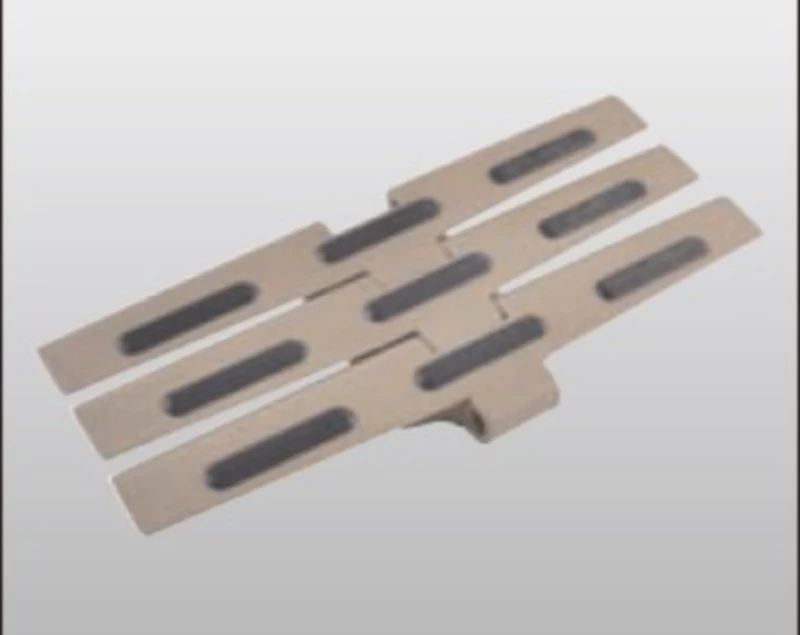
The LF821-K1000G is the 1000 mm width variant of the LF821G double hinge rubber-top flat top chain — the correct specification for wide-format inclined conveying where the product load or chain width exceeds the structural limits of the single hinge LF820G series. The double hinge design distributes transverse bending stress across two pins at each link joint, extending hinge bore service life by 40–60% at wide widths compared to single hinge equivalents at the same load. The rubber strip raises the coefficient of friction from approximately 0.20 (standard POM surface) to 0.50–0.70, enabling inclines up to approximately 20 degrees at standard loads. EverPower plastic chain Australia Pty Ltd supplies the LF821-K1000G as a direct replacement for System Plast 821-K1000G.
Rubber strip compound: standard vulcanised SBR/NBR, polyurethane on request. Maximum incline approximately 15–20 degrees at 1000 mm width with rated product load. Working load 3,000 N (double hinge reinforced plate). Max. straight run 12 m. Operating temperature: chain body -40 C to +90 C, rubber strip -20 C to +80 C. SUS304 stainless steel double hinge pins. 25.4 mm pitch. 5 ft per box at 26 links per metre (wide chain packing). Contact the EverPower team for polyurethane rubber option.
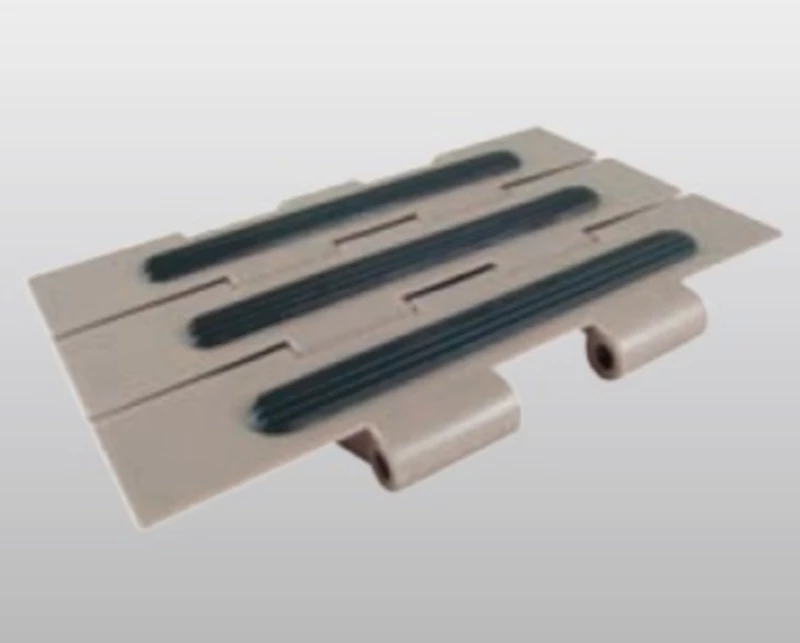
Technical Specifications — LF821-K1000G
| Parameter | Value |
|---|---|
| Chain series | LF821G (double hinge, rubber-top) |
| Width designation | K1000 (1000 mm) |
| Rubber strip compound | Vulcanised SBR/NBR (PU on request) |
| CoF (rubber on PET/glass/carton) | 0.50–0.70 |
| Max. incline (standard loads) | 15–20 degrees (width and load dependent) |
| Working load | 3,000 N (double hinge reinforced plate) |
| Max. straight run | 12 m |
| Max. speed (dry) | 60 m/min |
| Rubber strip temp. range | -20 C to +80 C |
| Chain body temp. range | -40 C to +90 C |
| Pitch | 25.4 mm |
| Packing | 5 ft / box (26 links/m) |
Double Hinge at K1000: Why It Is the Correct Specification
At 1000 mm chain width, single hinge chains carry transverse bending loads that cause measurable hinge bore elongation within 12–18 months at the product loads typical for rubber-top incline conveying at this width. Double hinge reduces midspan bending stress by approximately 65–75%, extending hinge bore service life to 24–36 months. On an incline conveying application where the rubber strip already limits service life to 18–30 months, the double hinge ensures the chain body outlasts the rubber strip — allowing rubber strip replacement to be the maintenance trigger rather than full chain replacement due to hinge bore failure.
The practical consequence: on a 12-metre K1000 rubber-top incline at wine bottle loads of 10–15 kg/m, the LF821-K1000G hinge bore service life is estimated at 28–36 months. Rubber strip service life is approximately 20–28 months. The planned maintenance event is rubber strip replacement at the 20–24 month mark, with the chain body continuing in service for the subsequent 8–12 months until the next rubber strip replacement. Total chain body service life: 36–48 months across two rubber strip replacements.
Wide Incline Applications at K1000
At K1000, the LF821G handles three-file inclined conveying of standard beverage cases and two-file inclined conveying of 750 ml glass wine bottles. Product loads at three-file case conveying on K1000 reach approximately 12–20 kg/m depending on case weight. The double hinge at K1000 is non-negotiable: single hinge bore elongation at these loads and this width reaches the replacement threshold within 8–12 months. LF821-K1000G is the standard specification for inclined case conveyor sections in wine distribution centres and large grocery DCs throughout Australia.
Matched Components EverPower Supplies
| Component | Description | Availability |
|---|---|---|
| LF821-K1000G Double Hinge Sprockets | Rubber-top tooth clearance, double-pin profile | Stock on request |
| Replacement Rubber Strips (K1000) | SBR/NBR standard and PU variants | On request |
| LF821 Double Hinge Standard (no rubber) | For flat sections adjacent to incline | In stock |
| LF820G Single Hinge Rubber Top | For narrower incline sections below K750 | In stock |
What Our Customers Say
“LF821-K1000G on our wine distribution centre K1000 at 12 degrees. Double hinge at this width is clearly the right call — we had a single hinge rubber-top chain from a previous supplier at K1000 and were replacing it every 14 months due to hinge bore wear. LF821G at 26 months: bore wear within specification.”
— Maintenance Manager, Wine DC, Adelaide SA
“The 5-foot box packing at wide widths is a handling detail that matters. A 10-foot box of K1000 rubber-top double hinge chain would weigh around 28 kg — above safe manual handling. 5-foot boxes at 14 kg allow single-person installation. That practical consideration reflects product knowledge.”
— Logistics Coordinator, FMCG Distribution, Melbourne VIC
“Rubber strip service life at our 1000 mm width with standard grocery case loads has been 22 months. We replaced the strips at the annual shutdown and continued with the same chain body. EverPower supplied the replacement strip sets pre-cut to width. Strip replacement took 45 minutes per 5-metre section.”
— Engineering Team, Distribution Centre, Brisbane QLD