Description
Product Overview
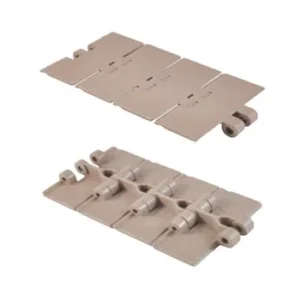
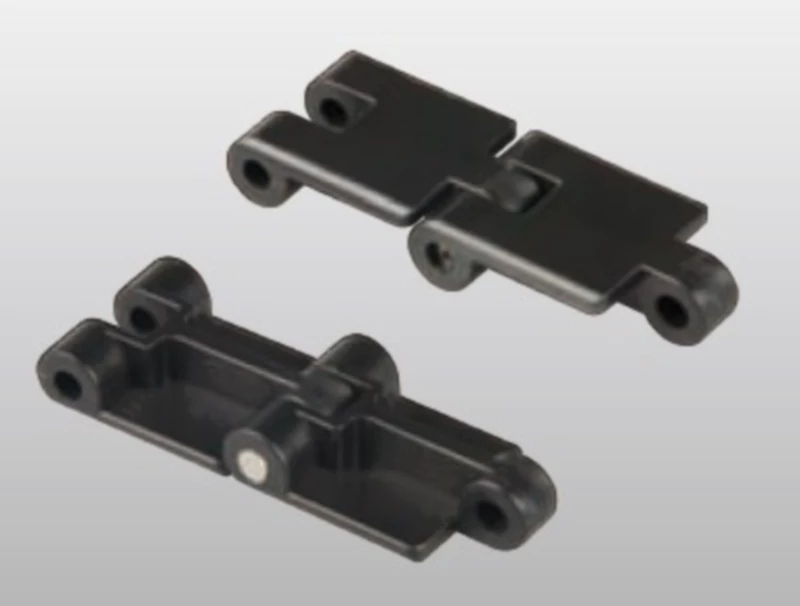
Mini flat top chains address the conveying problem that standard pitch flat top chains cannot solve: small, light, or unstable products whose base dimensions are comparable to or smaller than the chain link pitch. When the product base length approaches the chain link pitch of 25.4 mm (1 inch), successive chain links engage and disengage at the drive sprocket in a rhythm that causes periodic product acceleration and deceleration — the polygon effect — that manifests as product rocking, lateral displacement, and tip events on high-speed lines. The mini flat top design resolves this by reducing effective link length by approximately 40%, doubling the number of link engagement events per revolution and dramatically smoothing the conveying surface velocity profile. EverPower plastic chain Australia supplies single hinge mini flat top chains as direct replacements for System Plast 820 mini series.
All mini flat top variants are available in standard natural POM (white), black POM, and anti-static POM grades. The chain body connects with standard stainless steel pins and is compatible with the same guide rail and wear strip system as the full-size LF820 series — allowing mixed mini and standard pitch chain deployment on the same conveyor line without frame modification.
Why Mini Flat Top Is the Technically Correct Choice for Small Products
The polygon effect on a standard 25.4 mm pitch chain at 60 m/min produces a velocity variation of approximately ±4.9% with 10-tooth sprockets. For a 500 ml PET bottle with a 58 mm base diameter, this velocity variation translates to a horizontal acceleration at the base of approximately 0.15 g at 60 m/min — below the tipping threshold for standard bottles with a base-to-height ratio above 0.35. However, for a 30 mm diameter vial with a base-to-height ratio of 0.25, the same velocity variation generates an angular acceleration that exceeds the tipping threshold by a factor of approximately 2.5. The vial tips.
Mini flat top chain at the same speed, with its reduced link pitch, produces a velocity variation of approximately ±2.1% under equivalent sprocket conditions — cutting the effective polygon excitation of the product by more than half. For 30 mm diameter vials, this typically brings the horizontal acceleration at the base below the tipping threshold and eliminates the tip events that would otherwise require line speed reduction to manage. The mini flat top chain, in short, allows the full rated line speed to be maintained on small-product lines without resorting to guard rails that would constrain throughput.
Mini Flat Top Chain Variants
| Variant | Top Surface | Width Range | Special Feature |
|---|---|---|---|
| LF820 Mini (Standard) | Flat POM | K118 to K450 | Standard mini, universal small-product |
| LF820 Mini Single Hinge | Flat POM | K118 to K450 | Single hinge pin, lightest weight option |
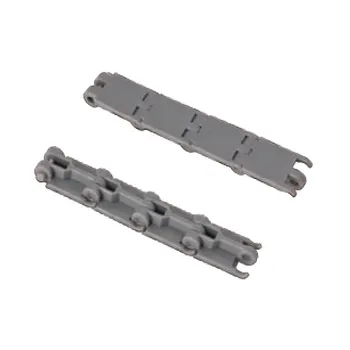
| LF820 Mini Straight Chains | Flat POM, rigid link | K118 to K450 | Stiffer surface for precise product positioning |
| LF820 Mini Lifting Chain | Roller top (mini) | K118 to K325 | Zero-pressure accumulation for vials/small bottles |
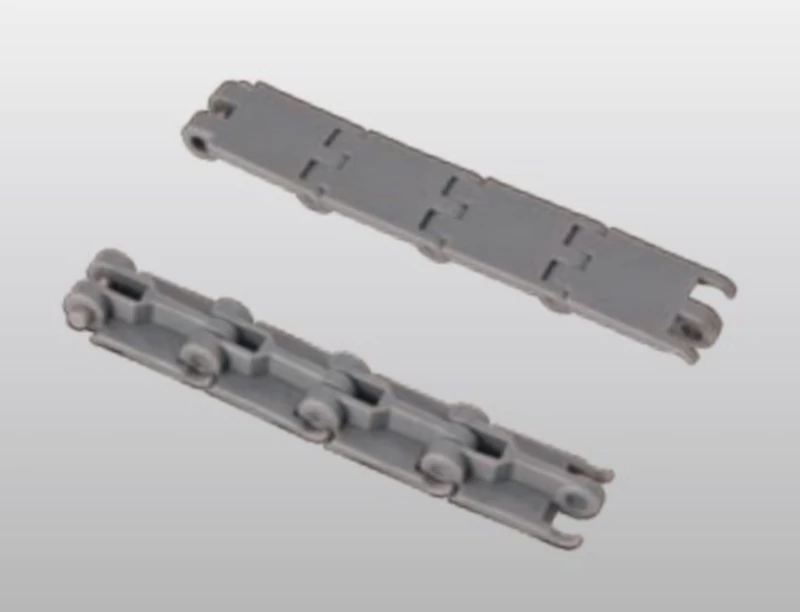
Mini Lifting Chain with Rollers: Zero-Pressure Accumulation
The mini lifting chain variant integrates miniature rollers into the top surface of each link. The rollers project approximately 1–2 mm above the chain plate surface and rotate freely on their own axles. When product rests on the chain surface and the chain is in motion, product sits on the roller tips and experiences only rolling friction rather than sliding friction against the chain surface. The practical consequence is that when product accumulates against a downstream stop, the chain continues moving under the accumulated product mass without generating the back-pressure that would otherwise push the accumulated product column against the stop with force proportional to the total product weight in the accumulation zone.
In pharmaceutical vial handling, where back-pressure accumulation force can cause vial-on-vial contact damage and cosmetic rejection, the mini lifting roller chain is frequently the specified solution. Accumulation back-pressure is reduced by approximately 70–85% compared to a standard flat-top accumulation zone of the same length, allowing accumulation zones up to 3–4 metres to be built without requiring supplementary back-pressure relief mechanisms. This directly reduces line complexity and the number of pneumatic or servo-controlled buffer gates needed in the conveyor system.
Applications Where Mini Flat Top Is Specified
The mini flat top chain is the standard specification for pharmaceutical vial and ampoule conveying (30–50 mm diameter), cosmetic tube and small bottle handling, laboratory sample tube conveying, miniature aerosol can transport, small confectionery and chocolate product conveying, and electronics component handling in clean-room assembly environments. In each of these, the product’s small base dimension relative to the standard chain pitch is the disqualifying factor for standard flat top chain, and mini flat top is the solution.
Matched Components EverPower Also Supplies
| Component | Description | Availability |
|---|---|---|
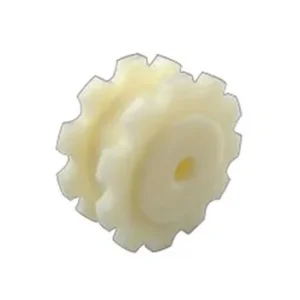
| Mini Flat Top Sprockets | Matched to LF820 mini pitch and width range | ✓ On request |
| Stainless Connecting Pins (mini) | For all mini flat top series | ✓ In stock |
| LF820 Standard Flat Top | For larger products on same line | ✓ In stock |
| Wear Strips — UHMWPE | Cut to width for mini flat top conveyor frames | ✓ On request |
What Our Customers Say
“Switched from standard LF820 to mini flat top for our 35 mm vial conveyor. Product tip events were running at approximately 12 per shift at 45 m/min. After the mini flat top installation: zero in the first two weeks, and we have maintained that. Line speed confirmed at 45 m/min — no reduction needed.”
— Validation Engineer, Pharmaceutical Packaging, Melbourne VIC
“Mini lifting roller chain on our 4-metre vial accumulation zone. We used to need a pneumatic buffer gate every 1.2 metres to control back-pressure. With the roller chain we removed all three intermediate gates and the accumulation zone runs without vial-on-vial contact. Significant reduction in line complexity.”
— Automation Engineer, Pharmaceutical Production, Sydney NSW
“We were sceptical that the mini pitch change would make a meaningful difference on our cosmetic tube line at 40 m/min. The OEE data after 3 months of mini flat top running is clear — tube tip events dropped by 94% compared to the standard pitch chain we replaced. The physics works.”
— Production Manager, Cosmetics Manufacturing, Brisbane QLD